
電池護照不是貼個二維碼:2027年前,供應商要準備什麼?
歐盟電池護照有明確適用範圍,卻不是所有信息同時必填。把2026年最新指引轉成數據責任、證據追溯、訪問權限和可交付的最小試點,避免先買平臺再找數據。
Topics & keywords
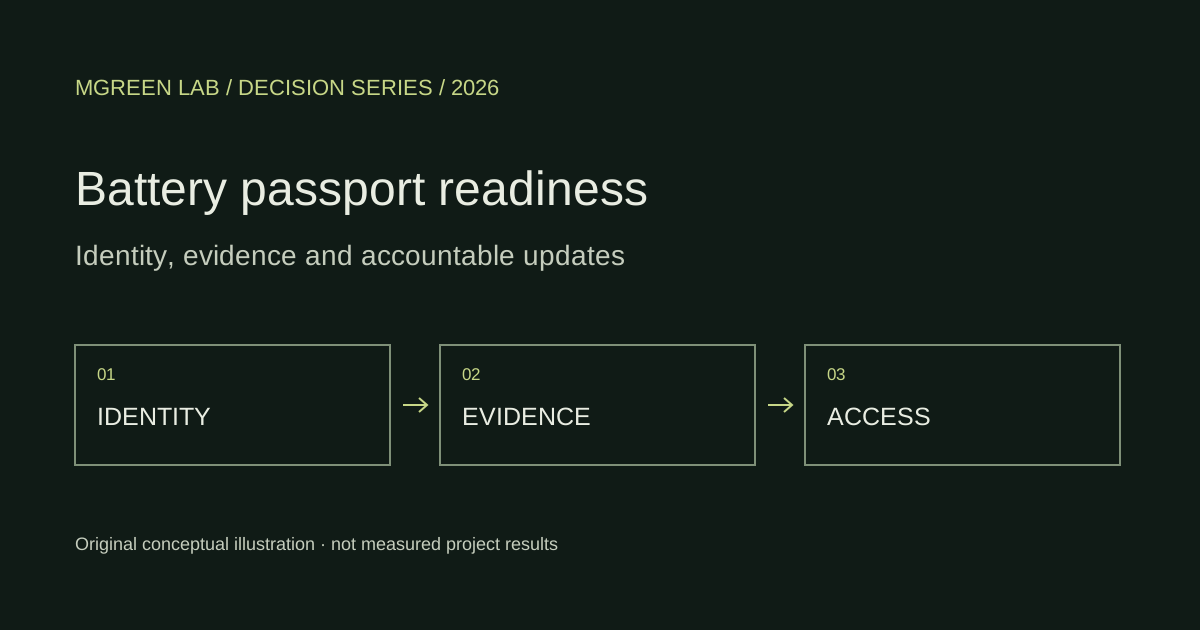
The difficult questions sit behind the code: which battery the data describes, who is responsible, who can see it and who updates it after a status change. Start with product scope and application dates, then test one real battery’s lifecycle; do not publish the entire supply chain by default.
01 | Establish scope before building
The Commission’s August 2026 guidance states that from 18 February 2027, EV batteries, light-means-of-transport batteries and industrial batteries above 2 kWh placed on the market or put into service require a passport. This is not simply “all batteries above 2 kWh”; the industrial threshold should not be applied indiscriminately to other categories. [1][2]
List products, uses, the finished-battery boundary, market role and timing before mapping requirements. A cell supplier may provide essential inputs without being the party responsible for a finished battery’s passport; a non-EU location alone is not a sufficient exclusion. Confirm the actual boundary with the team responsible for market access.
02 | The 2026 guidance does not make every field due at once
The updated Commission guidance brings together 71 data points with category and applicability distinctions. It includes required, conditional, optional and not-yet-displayable information. The document supports preparation rather than creating additional legal obligations. “All 71 fields populated” is therefore a poor purchasing criterion. [1][3]
The Commission FAQ explains that carbon footprint, recycled-content and due-diligence information are not all due when passports launch; their underlying obligations have separate timelines. Design for future data without confusing “not yet applicable” with missing information, and never turn missing values into zeros. [2]
Some entry points to the latest consolidated legal text returned a bot-verification page during this review. We do not claim a clause-by-clause legal audit. Scope and implementation status were cross-checked against readable 2026 Commission guidance, FAQ and the original data-point document. A formal delivery must still check current legislation and delegated/implementing acts.
Figure 1 · Recorded milestones and announced application date
- DPP Registry operationalPublic record [5]
- Updated guidance announcementPublic record [1]
- GBA trials results eventPublic record [4]
- Passport obligation for in-scope categoriesAnnounced requirement; future date [5]
03 | The minimum unit is a traceable data record
A usable record needs a value, unit, model or individual identity, applicability, effective time, source evidence, owner and review state. Capacity without relevant test conditions is incomplete; a model-level declaration cannot stand in for an individual battery’s current condition. This record structure is our implementation recommendation.
A business may have ERP records, quality systems, supplier spreadsheets and test reports without consistent identifiers across them. Trace one real model and individual battery: where each currently applicable field comes from, when it expires and who resolves conflicts. Separate pending, not applicable and not yet applicable states rather than filling gaps with marketing text.
Before selecting a platform, ask for a correction exercise: after a source report changes, can the passport update, preserve version and ownership records, and notify authorised recipients? A working scan proves access to a page, not data governance.
Figure 2 · From identity to authorised records
- 01Model & individual identity
- 02Applicable fields & evidence
- 03Owner & review
- 04Authorised view & update
04 | Delegation does not make accountability disappear
The Commission FAQ permits written authorisation for another operator to create or update a passport, while responsibility for accurate, complete and current information must remain clear. Hosting provider, evidence supplier and responsible market operator are distinct contractual roles. [2]
GBA’s 2026 Operational Trials show companies testing exchange, verification and supply-chain collaboration. IONCOR describes simulated supply-chain data transfer; Sunwoda describes coordination across business, sustainability, quality, IT and supply-chain functions. These are useful implementation examples, but participation is not EU legal-compliance certification. [4]
The delivery gap is turning one demonstrable sample into an enduring service. New batches, supplier exits, corporate changes, repair and remanufacture can alter identity, ownership and valid information. Acceptance should cover failure, migration and exit, not only launch day.
05 | Design public and restricted views separately
The passport does not make all data public. The Commission FAQ distinguishes public access from other authorised users and notes that further rules for restricted access are still developing. Design roles, verification, field groups and access records now, without claiming that an internal matrix is regulator-approved. [2]
A trustworthy interface identifies whether information is model-level or individual, when it was updated, its evidence and status. Where access is unavailable it explains the next step without leaking fields. Repair, recycling and procurement views can serve different tasks; lawful access depends on applicable rules and authorisation, not the existence of a button.
Do not upload every document as a public attachment. Classify and redact, then test minimum access, expiry, correction and export. Match dynamic-data updates to applicable requirements and use conditions instead of promising continuous connectivity for every battery.
Figure 3 · Access-design task matrix
| Task | Implementation focus | Boundary |
|---|---|---|
| Public view | Public and currently applicable information | A scan does not make every document public |
| Authorised task | Match fields to role and applicable rules | An invented role is not legal access |
| Maintenance | Evidence, change, time and ownership | Dynamic does not always mean real-time connectivity |
Worksheet · What should be confirmed before proceeding?
06 | Deliver one working data chain before scaling
The recommended first delivery is an applicability register, data dictionary, evidence/owner matrix, permission prototype and end-to-end tests. Use one model and a small set of real units to test creation, authorised retrieval, correction, responsibility transfer and export; confirm when a new passport is legally required against current rules.
If data lacks owners, start with readiness discovery. If the records are sound but users cannot find information, focus on retrieval and multilingual interaction. Mgreen Lab can discuss research, information architecture, prototypes and collaboration workflows; legal interpretation, conformity assessment and testing belong with the relevant specialists.
The attached worksheet reports unresolved ownership and evidence rather than a “compliance score”. An initial discussion can use anonymised field examples and a role map without trade secrets or complete customer data. A bounded discovery exercise supports decisions better than a platform quote detached from the underlying records.
Take the worksheet or discuss a bounded question
Download bilingual worksheet (Markdown)
Use anonymised task or data examples to describe the problem, desired deliverable and acceptance criteria.
Discuss requirements with Mgreen Lab07 | Sources, timing and method
Evidence checked through 23 October 2026. This is public-evidence and product-implementation analysis, not a compliance verdict for a company. The 2026 milestones are public records; future dates are announced application dates. Task matrices and checklists are editorial recommendations, not substitutes for current law.
Inspectable sources
- European Commission — Guidance to support preparations for the Digital Batteries Passport2026-08-21 · Accessed: 2026-10-23Guidance is not an authoritative legal interpretation; update before a compliance decision.
- European Commission — EU Digital Product Passport FAQ for Batteries2026; live page accessed 2026-10-23 · Accessed: 2026-10-23Live guidance; access rules still developing. Some latest consolidated-law URLs were bot-blocked, so no full legal audit claimed.
- European Commission — Digital Batteries Passport: data points by category2026-08 (linked from 21 August guidance) · Accessed: 2026-10-23Not every listed data point is mandatory for every battery at launch; not an additional law.
- Global Battery Alliance — 2026 Battery Passport Operational Trials2026; results launch 2026-09-16 · Accessed: 2026-10-23Participant accounts and simulated trials, not independent EU conformity certification; GBA framework distinct from statutory passport.
- European Commission — Batteries / implementation timeline2026 live guidance · Accessed: 2026-10-23Indicative implementation timeline; verify newer documents.
Lifecycle questions · Workflow adoption
电池护照的难点在二维码背后:数据对应哪块电池、谁对准确性负责、什么人能看、状态变化后谁更新。对相关供应商,合理起点是按产品范围和适用日期建立数据清单,再验证一块真实电池的全流程,而不是把所有供应链信息一次性公开。
01|先确认适用范围,不把所有电池混在一起
欧盟委员会2026年8月指引说明,自2027年2月18日起,投放市场或投入使用的电动车电池、轻型交通工具电池,以及容量大于2 kWh的工业电池,需要电池护照。不能简化成“所有大于2 kWh的电池”,也不能把工业电池阈值套在其他类别上。[1][2]
先列产品、用途、成品边界、投放市场角色和时间,再核对规则。电芯供应商可以提供关键输入,但是否承担成品电池护照责任,要看实际交易与产品形成过程;“我们不是欧盟公司”也不是充分的排除理由。具体产品边界应与负责市场准入的团队核实。
02|2026年指引的关键:71项不是71项同时必填
欧盟委员会更新指引汇集71个数据点,按电池类别和适用条件组织。其中包含必需、特定情形适用、可选或当期不必显示的信息。它是帮助准备的指引,不新增法律义务;不应把“填满71项”作为采购验收标准。[1][3]
委员会 FAQ 进一步说明,护照启动时碳足迹、再生含量和尽职调查信息并非一律已经到期;这些义务有各自时间表。可提前设计字段和证据接口,但不能把尚不适用与数据缺失混为一谈,更不能把缺失写成零。[2]
本次读取欧盟法规最新合并文本的部分入口遇到反机器人验证,因此本文不声称逐条完成法律审计;范围和当期实施状态采用委员会可读的2026年指引、FAQ及原始数据点文件交叉核对。正式交付前仍需复核最新法规、授权法案与实施法案。
图 1 · 公开里程碑与已公布适用日期
03|真正的最小单元是可追溯数据,不是网页字段
一个可用数据记录至少需要值、单位、产品或个体标识、适用条件、有效时间、来源文件、责任人和审核状态。例如容量不能只填一个数字而省略测试条件;一个型号的声明也不能冒充某块在役电池的当前状态。这里的数据结构是本文提出的实施建议。
企业常有 ERP、质量系统、供应商表格和测试报告,却没有跨系统一致标识。先取一个真实型号与一个电池样本,追查每个当期适用字段从哪里来、何时失效、冲突谁解决。留存“待确认”“不适用”“尚未适用”的不同状态,比用营销文案填满页面更可靠。
采购平台前,让供应商演示更正流程:来源报告更新后,护照是否能同步、留下版本与责任记录、通知有权接收的人?只演示扫码打开页面,不能验证数据治理能力。
图 2 · 从标识到授权数据的可追溯链
- 01型号与个体标识
- 02适用字段与证据
- 03责任人与审核
- 04授权视图与更新
04|责任可以委托,准确性不能靠外包消失
委员会 FAQ 说明,负责运营者可以书面授权其他运营者代为创建或更新,但负责信息准确、完整和最新的责任仍须落实。平台托管方、资料提供方与投放市场责任方不应在合同里混为一个角色。[2]
2026年 GBA Operational Trials 展示了企业正在测试数据交换、验证和供应链协作。IONCOR披露使用模拟供应链测试跨组织数据转移;Sunwoda描述了跨业务、可持续发展、质量、IT与供应链的数据协同。这些试验可为实施提供启发,但参与试验不等于获得欧盟法律合规认证。[4]
商业交付的缺口是把一个可演示样本变成长期服务:新批次进入、供应商退出、企业重组、维修与再制造,都可能改变标识、责任和有效数据。验收应覆盖故障、迁移与退出,而不止上线当天。
05|公开可见与授权可见,必须从设计时分开
护照并不要求所有数据公开。委员会 FAQ 区分公众与其他有权访问者,同时指出受限访问的进一步实施规则仍在形成。此时可以先设计角色、身份验证、字段分组与审计记录,但不能把自定权限矩阵说成已经获得监管确认。[2]
一个可信界面应让使用者知道数据是型号级还是个体级、何时更新、来源与状态,并在没有权限时解释下一步,而不是泄露字段。面向维修、回收和采购的视图可以围绕不同任务组织;是否具有合法访问权则由适用规则和授权决定,不能由页面按钮决定。
避免把所有文档都作为公开附件上传。先做数据分类与脱敏,验证最小权限、权限失效、纠错和可导出性。动态数据的更新节奏也应与适用要求及使用情形匹配,不凭空承诺所有电池实时联网。
图 3 · 权限设计任务矩阵
| 任务 | 实施关注 | 边界 |
|---|---|---|
| 公众查询 | 可公开且当期适用的信息 | 不可据扫码公开全部技术资料 |
| 授权任务 | 按角色和适用要求核对字段 | 不能用自定角色替代合法访问权 |
| 维护与更正 | 记录来源、变更、时间与责任人 | 动态更新不意味着全部实时联网 |
工作表 · 进入下一步前要确认什么?
06|先交付一条可运行的数据链,再扩大范围
建议的首阶段交付物是适用性清单、数据字典、来源责任矩阵、权限原型与一组端到端测试。选择一个型号及少量真实个体,测试创建、授权查询、数据更正、责任转移和导出;具体情形是否需要新护照,应依最新规则确认。
如果数据还没有责任人,先做准备度诊断;若数据已稳定但用户找不到信息,再做查询体验与多语言界面。Mgreen Lab 可围绕需求研究、信息架构、原型与协作流程讨论项目;法律解释、合格评定与检测应由对应专业方承担。
附带工作表不输出“合规分数”,而是列出未解决责任与证据。首次交流可以提供匿名字段样例和供应链角色图,不必发送商业秘密或完整客户数据。一个范围清楚的诊断,比没有数据基础的平台报价更有决策价值。
带走工作表,或讨论一个范围明确的问题
可使用匿名任务或数据样例,说明当前问题、预期交付物和验收方式。
与 Mgreen Lab 讨论需求07|来源、时点与方法
资料核查截至2026年10月23日。本文是公开证据与产品实施分析,不是某企业的合规结论。图中2026年里程碑为公开记录,后续日期为已公布适用时间;任务矩阵与清单是编辑建议,不能替代最新法规。
可核查来源
- European Commission — Guidance to support preparations for the Digital Batteries Passport2026-08-21 · 访问:2026-10-23指引并非权威法律解释;合规决策前须检查更新。
- European Commission — EU Digital Product Passport FAQ for Batteries2026; live page accessed 2026-10-23 · 访问:2026-10-23动态指引,受限访问规则仍在形成;最新合并法规部分入口被验证页面阻挡,未声称完成法律审计。
- European Commission — Digital Batteries Passport: data points by category2026-08 (linked from 21 August guidance) · 访问:2026-10-23并非所有字段对所有类别在启动时都必填;文件不新增法律。
- Global Battery Alliance — 2026 Battery Passport Operational Trials2026; results launch 2026-09-16 · 访问:2026-10-23参与者披露与模拟试验,非独立欧盟合规认证;GBA框架与法定护照不能混同。
- European Commission — Batteries / implementation timeline2026 live guidance · 访问:2026-10-23实施指引时间线,使用前须核对较新文件。