
AI 原型更快,用户验证跟上了吗?从可点击界面到可行动证据
从 2026 年设计工具试验、可用性研究与企业案例,区分原型产量和用户证据;用交互模型检验研究容量与问题发现条件。
Topics & keywords
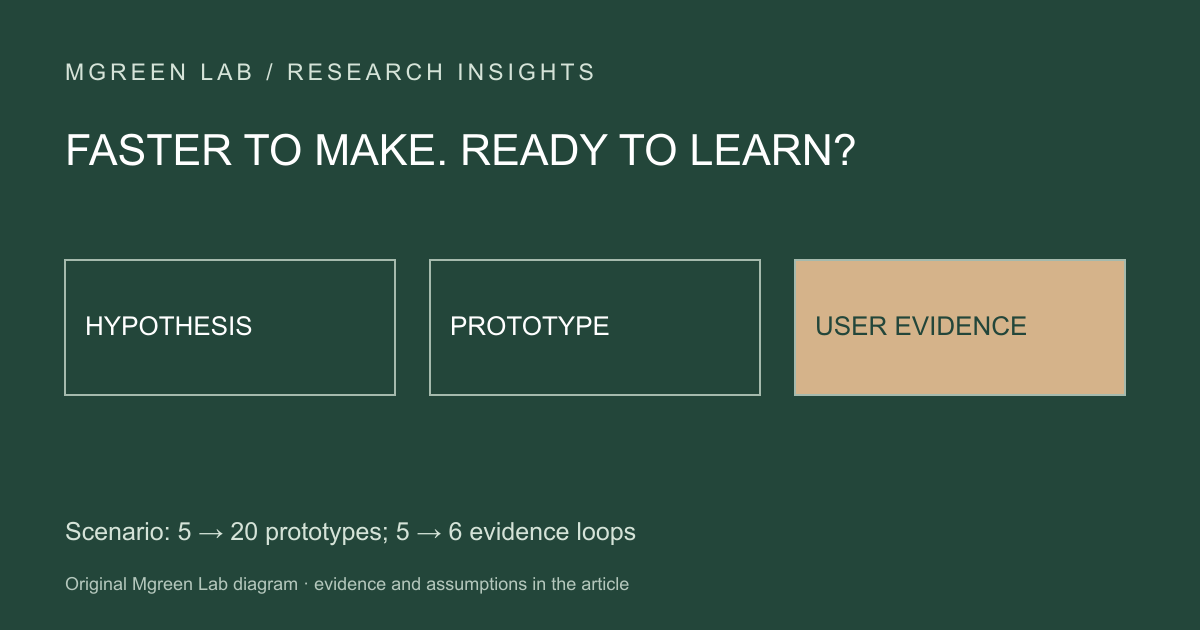
AI can reduce the cost of making an idea clickable. A generated interface does not establish that users need it. Value emerges when target users attempt credible tasks and the team changes a decision in response. As prototypes become easier to make, scarce research time should address the most consequential uncertainty.
Evidence reviewed through 23 October 2026. Mgreen Lab analyses external studies and company disclosures; all original model inputs are hypothetical. Tool-production efficiency, interface usability and market demand remain distinct outcomes.
1. Production evidence first answers a production question
A September 2026 preprint by Figma researchers randomised 50 product designers and 50 product managers across three standardised tasks. The equally weighted task-time estimate was about 20% shorter among successful completions. The authors warn that tool access also affected completion, changing the composition of those compared.[1]
This is not a claim that any product reaches market 20% faster. Tasks had predetermined target designs and completion checks; the experiment did not establish that end users wanted the features. Treat it as production evidence, then separately test user tasks and demand.
Figure 1 · The evidence chain
- 01 · HypothesisWhat would change the choice?
- 02 · PrototypeImplement what the test requires
- 03 · User taskTarget users, context, behaviour
- 04 · DecisionRevise, proceed, stop or investigate
Original Mgreen Lab operating framework: a checking sequence, not proof of completed steps.
2. Greater realism can also influence judgement
A CHI 2026 paper’s public abstract describes 48 participants comparing four pairs of functionally equivalent prototypes labelled new or old. Novelty framing affected preference and subjective ratings.[2] We read the public abstract and procedure description; full-PDF access was limited, so no maximum percentage is generalised as a universal bias.
A polished AI prototype can shift a review from whether an assumption holds to whether an apparent finished product looks good. Use neutral instructions, rotate presentation order where appropriate, observe behaviour before asking preference, and retain both forms of evidence.
Figure 2 · Similar percentages, different outcomes
| Evidence | Population/task | Measure | Does not establish |
|---|---|---|---|
| Figma 2026 preprint [1] | 100 creators / three tasks | Production time ~−20% among completed tasks | Not end-user demand |
| Google CHI 2026 abstract [3] | 48 users / ten apps | User task time ~−20% across design systems | Not AI production speed |
| Workplace cases [4][5] | PMs, clinical feedback, form comparisons | Disclosed workflow use | Not controlled business impact |
Studies are not pooled into a tool ranking; unavailable intervals are not invented.
3. Usability measures should follow user tasks
A Google team’s official abstract for a CHI 2026 study reports that 48 participants used ten applications; versions following Material 3 Expressive guidelines produced roughly 20% faster user task completion than the prior design system.[3] This and Figma’s 20% measure different things: user operation versus producing a design.
A checkout prototype can reveal misunderstood address fields without establishing payment reliability, willingness to buy or repeat purchasing. Define the decision and observable failure first, then choose fidelity. Navigation may not need a full backend, while testing input recovery may need more than static links.
4. Workplace cases shorten the feedback path
Figma’s Civica story describes product managers creating discussable models, then engaging designers, engineers and busy clinical users, while retaining engineering feasibility checks.[4] It is a vendor-published workflow account without an independent business-outcome comparison; easier feedback is not evidence of better patient services.
UserTesting’s April 2026 general-availability announcement says CarMax used its Figma integration to compare ways of structuring complex multi-step forms.[5] Test planning, human feedback and design revision are an available service chain. Each project still needs participant criteria, tasks and original observations; an AI summary is not a substitute.
5. An original capacity model: four times the prototypes, not the evidence
Treat production and research as separate role-specific hour budgets. With Bp=40 production hours, baseline b₀=8 hours yields five prototypes; an AI scenario b₁=2 yields twenty. Br=30 research hours, preparation u=1, m=5 participants at h=0.5 hours each and synthesis z=1 gives 4.5 hours per study and capacity for six.
Complete evidence loops are min(floor(Bp/b), floor(Br/(u+mh+z))): five at baseline, six with AI, leaving fourteen unstudied prototypes. All inputs are illustrative, not company measurements. The model excludes recruitment waiting, cross-round revisions and shared-staff conflicts, and cannot determine whether a study is sufficient for a decision.
Production savings can reduce premature polish, support more distinct hypotheses or expand research capacity. Do not automatically fill the pipeline with variants. If the same people produce and research, allocate actual hours between roles before entering budgets; one hour cannot be spent twice.
Figure 3 · Production and research capacity (scenario counts)
| Item | Value |
|---|---|
| Baseline built | 5 |
| AI built | 20 |
| Study capacity | 6 |
| AI complete loops | 6 |
Original defaults: complete loops limited by the smaller capacity. Production and research are different measures.
Interactive model · Inspect your assumptions
K=floor(Bp/b); R=floor(Br/(u+mh+z)); L=min(K,R)
All assumptions. Separate role-hour pools; no recruitment waits, revisions or shared-staff conflict. Loop count is not evidence adequacy. Do not double-count role hours.
6. Five users are not a universal discovery guarantee
For one defined usability issue, if each suitable participant independently detects it with probability p, the scenario probability of at least one detection is 1−(1−p)^m. At p=20% and m=5 it is about 67.2%; at p=5%, the same five yield only about 22.6%. The probabilities are assumptions, not universal constants from a study.
Actual users differ by expertise, device, language and path, and detection can be correlated. This is not a sample-size method for satisfaction surveys, conversion experiments or confidence intervals. It illustrates why rare problems and unrepresented users remain uncertain even when a prototype looks finished.
Figure 4 · Finding one assumed issue
| Participants m | p=5% | p=20% | p=50% |
|---|---|---|---|
| 3 | 14.3% | 48.8% | 87.5% |
| 5 | 22.6% | 67.2% | 96.9% |
| 8 | 33.7% | 83.2% | 99.6% |
| 12 | 46.0% | 93.1% | 100.0% |
P(≥1) = 1 − (1−p)^m
Original scenario: homogeneous independent participants, one fixed issue. Not a confidence interval, power calculation or conversion-test sample size. Actual p is unknown.
7. Give each test a decision it can change
Attach a short study brief: target users, hypothesis, realistic task, observation method, what would trigger revision or abandonment, and capabilities not simulated. Fix key records before testing, retain a comparator and avoid selecting only clips supporting a preferred design.
Separate discovering a problem from resolving it: retest the affected path after revision. Separate ease of use from willingness to pay: demand, pricing and continued use require appropriate designs. A strong prototype helps ask better questions rather than declaring every question settled.
8. Faster prototypes should help teams learn earlier
Good initial conditions include clear tasks, quickly reviewable output, reachable participants and ownership of turning feedback into action. If research is already capacity constrained, first adjust scheduling and responsibility rather than seeking more clickable artefacts.
The opportunity is to turn cheaper production into earlier exposure of uncertainty: less untested commitment and more recorded learning capable of overturning a choice. Track which consequential decisions changed and which uncertainties remain, alongside prototype counts.
Sources, limitations and related reading
- Does AI Save Time on Product Design? A Randomized Controlled Experiment of AI Prompt-to-Design WorkflowsStewart, Anise, Hogan & Griffin — Figma; arXiv preprint · 2026-09-22 · Vendor-authored randomised experiment / 供应商作者随机试验 · Accessed 2026-10-23 · DOI 10.48550/arXiv.2609.26725Completion-conditioned estimates; tool affects completion. Fixed target design, no end-customer demand outcome; not all design-to-launch time / 以完成者为条件,工具影响完成概率;固定目标图,未测终端需求,不是整个产品周期。
- Quantifying the Novelty Bias when Evaluating Interactive PrototypesMa, Hiniker & Wobbrock — CHI 2026 · 2026-04-13 · Within-subject experiment / 被试内试验 · Accessed 2026-10-23 · DOI 10.1145/3772318.3791685Publisher direct fetch 403; author PDF exceeds tool size limit. Public primary abstract/procedure only; no universal maximum effect asserted / 出版页直读403、作者PDF超工具上限;仅读公开摘要/程序描述,不泛化最大效应。
- Usability Hasn’t Peaked: Exploring How Expressive Design Overcomes the Usability PlateauBentley et al. — Google Research; CHI 2026 · 2026-04 (conference) · User-task experiment, official abstract / 用户任务实验官方摘要 · Accessed 2026-10-23Official abstract read, full methods not accessed; design-system comparison, not AI production effect or demand / 仅读官方摘要;设计系统比较,非AI制作效应或需求。
- How Figma Make empowers product managers at CivicaFigma customer story / Civica account · Undated public page · Vendor-published workplace case / 供应商客户案例 · Accessed 2026-10-23Selected testimonial, no independent controlled outcome or patient-service efficacy / 选择性案例,非独立对照效果或患者服务验证。
- UserTesting Brings Real Customer Feedback into Figma… Now Generally AvailableUserTesting · 2026-04-21 · Product launch and attributed case / 产品发布与客户披露 · Accessed 2026-10-23Vendor disclosure, not independently audited time savings or conversion uplift / 企业披露,非独立节时或转化提升审计。
Enterprise RAG answer reliability · AI coding and complete delivery effort
Original Mgreen Lab writing, figures and models. No third-party photographs or paper figures reproduced. Scenarios, capabilities and research results retain distinct labels.
AI 可以降低把想法做成可点击界面的成本,但界面生成完成,不等于用户需求得到验证。价值出现在下一步:目标用户能否在可信的任务情境中完成工作,团队能否根据观察改变决定。原型越容易制作,越应把稀缺的研究时间用在最重要的不确定性上。
资料核验截至 2026 年 10 月 23 日。本文为 Mgreen Lab 对外部研究与企业披露的分析;原创模型参数均为假设。区分工具制作效率、原型可用性和产品市场需求,不将三者混成一个成功率。
1. 制作效率的证据,首先只回答制作问题
Figma 研究者于 2026 年 9 月公开的预印本,随机分配 50 位产品设计师与 50 位产品经理,完成三项标准化任务。对成功完成的任务,按任务等权汇总的估计约节省 20% 时间;作者同时明确,完成与否受工具影响,因此仅比较完成者会改变组间样本。[1]
这不是“任意产品从想法到上线快 20%”。任务有既定目标图,质量判定也主要围绕完成指定设计;研究没有验证终端用户是否需要这些功能。产品团队可把它看成制作能力的证据,再另设用户任务与需求检验。
图 1 · 需要贯通的证据链
- 01 · 假设什么结果会让我们改变方案?
- 02 · 原型只实现测试需要的行为
- 03 · 用户任务目标人群、情境、操作记录
- 04 · 决定修改、继续、放弃或补充证据
Mgreen Lab 原创工作框架,表示检查顺序,不表示每一步已被证实。
2. 外观更真实,也可能让判断更容易受影响
2026 年 CHI 论文的公开摘要描述了 48 人对四对功能相同原型的比较,其中一版标作“新”、另一版标作“旧”;偏好和主观评分受到新颖标签影响。[2] 本文读取了公开摘要与程序描述,完整 PDF 抓取受限,因此不把其中最大百分比当作普遍偏差幅度。
AI 制作的高保真页面容易让评审从“这个假设对吗”转为“这个成品好看吗”。测试说明应中性,不暗示某版更先进;展示顺序适当轮换,记录参与者做了什么,再询问喜欢什么。偏好仍有价值,但需要与行为证据并列。
3. 可用性指标应跟着用户任务,而非生成过程
Google 团队一项 2026 年 CHI 研究的官方摘要报告:48 名参与者在 10 个应用上完成任务,按 Material 3 Expressive 指南制作的版本,相较前一版设计系统,任务完成约快 20%。[3] 这与上一节 Figma 试验的“20%”不是同一指标:一个计用户操作,一个计制作者完成设计。
一个结账原型可以测试地址填写是否被误解,却不能仅靠点击顺利证明支付可靠、购买意愿或长期复购。先写下决策与可观察的失败条件,再选择原型保真度。只为回答导航问题时,无需模拟所有后台;要验证输入纠错时,静态跳转又可能不够。
4. 企业案例表明,反馈链路本身也在变短
Figma 的 Civica 客户故事描述,产品经理先生成可讨论的模型,再与设计、工程和忙碌的临床用户交流;它还保留工程可行性核查。[4] 这是供应商发布的工作流程案例,未提供独立对照的业务收益,不能把“更容易获得反馈”直接写成患者服务改善。
UserTesting 于 2026 年 4 月公布 Figma 插件正式可用,披露 CarMax 用其比较复杂多步表单的组织方式。[5] 这说明“生成测试计划—取得真人反馈—回到设计”已经成为可提供的服务链条;具体项目仍需检查招募对象、任务和原始观察,AI 总结不能替代这些记录。
5. 原创容量模型:四倍原型,不等于四倍验证
将制作与研究视为两个有独立工时预算的角色池。制作预算 Bp=40 小时,传统每个原型 b₀=8 小时,可制作 5 个;AI 情景 b₁=2 小时,可制作 20 个。研究预算 Br=30 小时,每个概念需准备 u=1 小时、m=5 位参与者各 h=0.5 小时,以及综合 z=1 小时,每轮共 4.5 小时,最多完成 6 轮。
完整证据循环数为 min(floor(Bp/b), floor(Br/(u+mh+z))):基线 5 轮,AI 情景 6 轮,而未研究原型积压变成 14 个。所有输入均为演示假设,不是上述公司的实测。模型不计招募等待、跨轮修改与共享人员冲突,也不判断哪一轮足以支持决策。
因此,制作端的节省可以用于减少过早打磨、探索更不同的假设,或扩大研究容量,而不是默认把候选数堆满。若研究与制作由同一批人承担,应先重新分配实际工时,再输入两个预算,不能把同一小时使用两次。
图 3 · 制作与研究容量(假设,个/轮)
| 项目 | 数值 |
|---|---|
| 基线制作 | 5 |
| AI制作 | 20 |
| 研究容量 | 6 |
| AI完整循环 | 6 |
原创默认情景,完整循环受两侧较小容量约束;制作与研究不是同一指标。
交互模型 · 检查自己的假设
K=floor(Bp/b); R=floor(Br/(u+mh+z)); L=min(K,R)
全部为假设。独立角色工时预算,不含招募等待、跨轮修改、共用人员冲突;循环数不等于证据充分性。研究工时不应与制作工时重复。
6. 五位用户不是普遍的发现保证
对一个已经定义的可用性问题,若每位合适参与者独立发现它的概率为 p,m 人至少发现一次的情景概率是 1−(1−p)^m。p=20%、m=5 时约为 67.2%;若 p=5%,同样五人只有约 22.6%。这里 p 是假设,不是从某篇研究借来的通用常数。
真实用户会因经验、设备、语言和任务路径而分群,发现事件也可能相关。这个公式不是满意度调查、转化率实验或统计置信区间的样本量算法。它的用途是提醒团队:低频问题与未覆盖人群,不会因一个原型看起来成熟而自动被验证。
图 4 · 发现同一个假设问题的机会
| 参与者 m | p=5% | p=20% | p=50% |
|---|---|---|---|
| 3 | 14.3% | 48.8% | 87.5% |
| 5 | 22.6% | 67.2% | 96.9% |
| 8 | 33.7% | 83.2% | 99.6% |
| 12 | 46.0% | 93.1% | 100.0% |
P(≥1) = 1 − (1−p)^m
原创情景;同质、独立参与者,一个固定问题。不是置信区间、统计功效或转化实验样本量;p在实践中未知。
7. 让每次测试都能改变一个决定
每个原型附一张简短任务卡:目标用户、待检验假设、真实任务、观察方式、何种结果会让团队修改或放弃,以及尚未模拟的系统能力。测试前固定关键记录项,避免事后只挑支持偏好的片段。对不同方案,同时保留比较基准。
将“找到问题”与“问题解决”分开:修订后需要复测相应路径;将“好用”与“有人愿意付费”分开:需求、价格和长期使用应使用适合的研究设计。高质量原型是提出更好问题的工具,而不是把所有问题提前宣布解决。
8. 更快的原型,应该让团队更早学习
采用 AI 原型工具值得优先尝试的条件,是任务可清楚表述、生成结果能快速审查、研究对象能够触达,并有人负责把反馈变成行动。若团队已经缺少研究容量,首先改变排期和责任,而非再追求更多可点击稿件。
产品设计与管理的机会,在于把廉价制作转化成更早暴露的不确定性:少一些未经检验的投入,多一些有原始记录、可以推翻现有选择的学习。衡量重点可以从“这周做了多少原型”,转为“哪些关键决定因此改变,哪些风险仍未验证”。
来源、限制与延伸阅读
- Does AI Save Time on Product Design? A Randomized Controlled Experiment of AI Prompt-to-Design WorkflowsStewart, Anise, Hogan & Griffin — Figma; arXiv preprint · 2026-09-22 · Vendor-authored randomised experiment / 供应商作者随机试验 · 访问 2026-10-23 · DOI 10.48550/arXiv.2609.26725Completion-conditioned estimates; tool affects completion. Fixed target design, no end-customer demand outcome; not all design-to-launch time / 以完成者为条件,工具影响完成概率;固定目标图,未测终端需求,不是整个产品周期。
- Quantifying the Novelty Bias when Evaluating Interactive PrototypesMa, Hiniker & Wobbrock — CHI 2026 · 2026-04-13 · Within-subject experiment / 被试内试验 · 访问 2026-10-23 · DOI 10.1145/3772318.3791685Publisher direct fetch 403; author PDF exceeds tool size limit. Public primary abstract/procedure only; no universal maximum effect asserted / 出版页直读403、作者PDF超工具上限;仅读公开摘要/程序描述,不泛化最大效应。
- Usability Hasn’t Peaked: Exploring How Expressive Design Overcomes the Usability PlateauBentley et al. — Google Research; CHI 2026 · 2026-04 (conference) · User-task experiment, official abstract / 用户任务实验官方摘要 · 访问 2026-10-23Official abstract read, full methods not accessed; design-system comparison, not AI production effect or demand / 仅读官方摘要;设计系统比较,非AI制作效应或需求。
- How Figma Make empowers product managers at CivicaFigma customer story / Civica account · Undated public page · Vendor-published workplace case / 供应商客户案例 · 访问 2026-10-23Selected testimonial, no independent controlled outcome or patient-service efficacy / 选择性案例,非独立对照效果或患者服务验证。
- UserTesting Brings Real Customer Feedback into Figma… Now Generally AvailableUserTesting · 2026-04-21 · Product launch and attributed case / 产品发布与客户披露 · 访问 2026-10-23Vendor disclosure, not independently audited time savings or conversion uplift / 企业披露,非独立节时或转化提升审计。
Mgreen Lab 原创文字、图表与模型;未转载第三方照片或论文图。情景、产品能力与研究结果分别标注。