Contact us ↗
MY CREATIVE CENTERAI / DIGITAL PRODUCTS

AI APPLICATIONS & DIGITAL PRODUCTS

MY CREATIVE
CENTER

MY CREATIVE CENTER designs and develops AI applications and digital products. Our internal Mgreen Lab studies practical questions through scientific evidence, translating suitable findings into prototypes, digital tools and custom digital services.

  • AI applications & workflowsAI assistants · Knowledge applications · Prototypes
  • Websites & digital productsWeb development · Interaction design · Product experience
  • Brand & product communicationVisual identity · Graphic design · Digital touchpoints

Internal research byMgreen Lab ↗

Research informs decisions. Products test ideas.

SCROLL TO EXPLORE

MY CREATIVE CENTER / RESEARCH-DRIVEN INNOVATION

We focus on turning worthwhile problems into useful AI applications and digital products.

We connect needs research, experience design and development around a business context, defining the purpose before testing and refining the product.

<strong>Mgreen Lab</strong> connects research with practical use: start with evidence and a question, build a testable prototype, then develop evaluated approaches into digital products or custom services.

01 / ABOUT THE COMPANY

From real needs<br>to useful digital products.

AI makes new capabilities possible. A worthwhile product still depends on who will use it, the problem it solves and how it fits into everyday work.

Where can AI help? What experience do users need? Which assumptions should a small prototype test first?

These practical questions are where a MY CREATIVE CENTER project begins.

We bring needs discovery, interface and interaction design, web and application development into one project process. Mgreen Lab supports decisions that need further research; product development turns them into experiences we can test.

We start with a clear goal and a manageable scope, then improve through real use and feedback.

MY means originality.<br>It also means responsibility.

<strong>MY</strong> carries the initials of our founder, Ma Ye, and the English meaning of “my”.

It expresses our approach to original work: independent judgment and responsibility for the questions we ask, the designs we develop and the value we create.

Original work grows from a deep understanding of real problems and from bringing knowledge across disciplines into new approaches to solutions.

02 / AI & DIGITAL PRODUCT SERVICES

Our services.<br>What we can do for you.

We provide design, development and custom digital services around AI applications and digital products. We start with a workflow, knowledge-use or digital-experience problem and define the research, prototype and implementation scope together.

Mgreen Lab supports needs research, approach comparisons and prototype validation where the project requires them.

Three connected services for digital products. Explore sideways →

01 / 03
01

AI / WORKFLOWS

AI applications & workflows

<strong>Put AI to work with a clear purpose.</strong>

We design interactions and functionality for assistants, knowledge retrieval, content support and application prototypes around business tasks.

We establish data conditions, usage boundaries and human involvement before defining the implementation scope and moving into development.

Lab contribution: compare approaches and costs, and examine answer quality, reliability and evaluation methods.

FOCUS: AI applications · Workflows · Knowledge retrieval · Prototypes

Research: reliability in enterprise knowledge retrieval ↗
02

WEB / DIGITAL PRODUCTS

Websites & digital products

<strong>Turn brand and business needs into clear, usable websites and products.</strong>

We provide website pages, information architecture, interface and interaction design, and development.

We organise content, functionality and navigation around user tasks, connecting product communication with the experience of using it.

Lab contribution: research user needs and comparable approaches, then examine key choices through prototypes and feedback.

FOCUS: Web development · Information architecture · Interfaces & interactions · Digital experience

Explore website & digital projects ↗
03

BRAND / COMMUNICATION

Brand & product communication

<strong>Help people understand the brand and the value of the product.</strong>

We create logos, visual identities, graphic design and brand guidelines for consistent expression across websites, interfaces and product communication.

We organise visual and written communication around audiences, information hierarchy and usage contexts to support understanding and action.

Lab contribution: examine audience and context evidence, and assess whether communication is clear and reflects actual capabilities.

FOCUS: Visual identity · Graphic design · Brand guidelines · Product communication

Explore brand design projects ↗

03 / INTERNAL RESEARCH FOR PRODUCT WORK

MgreenLab

Internal research & product exploration.<br>From scientific evidence to digital applications.

数字界面与信息结构的研究示意
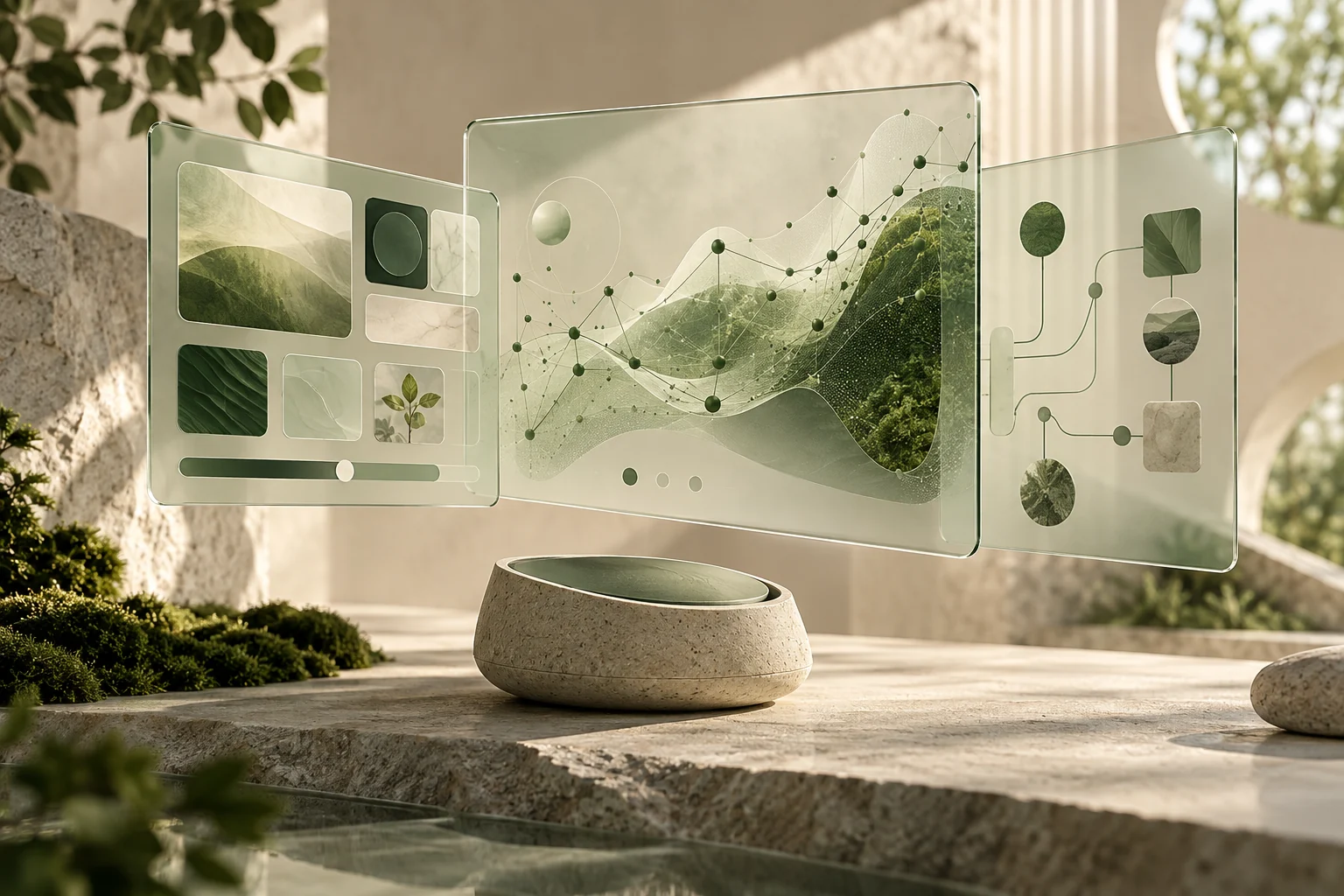
FROM QUESTIONS TO PRODUCT DECISIONSAI concept visual

Understand through scientific evidence.<br>Explore through digital products.

<strong>Mgreen Lab is the internal research practice of MY CREATIVE CENTER. Its work develops scientific analysis, prototypes and methods; findings suited to practical use can become digital products or custom digital services.</strong>

Research centres on practical project decisions: understanding users and workflows, comparing approaches, examining evidence and limitations, and identifying assumptions to test first.

Research articles distinguish published evidence, public data, model assumptions and interpretation, with scope and limitations stated. Prototypes and feedback examine practical applications; an article’s findings are not promises of product performance.

Green technology and sustainable design remain part of our knowledge base. Where relevant to a digital product, they inform resource costs, maintenance and long-term use. Broader topics remain available in the research archive.

How research supports product work

01

Needs & workflows

Map user tasks, existing workflows and obstacles to define the problem.

Inform scope, priorities and success criteria that the project can discuss.

02

AI approaches & reliability

Compare AI capabilities with conventional approaches, considering data, output quality, cost and limitations.

Identify where AI fits, where human review is needed and where a simpler implementation works better.

03

Prototypes & validation

Use interactive prototypes and small trials to examine experience and functionality.

Bring feedback into design and development to define the next improvement.

Research → prototypes → digital products & custom services

Articles clarify questions and evidence. Prototypes make an application testable. The company develops suitable directions into digital tools, AI applications or custom services for specific workflows.

Not every research topic needs a product. Development, evaluation and delivery scope are considered where findings fit a real need and practical conditions.

Explore research for product practice ↗

Published insights document evidence and reasoning. They do not imply completed client projects or experimental results; project work is presented with its actual scope.

PROJECTS / EXPLORATIONS

Project work

Work on websites, brands and digital experiences, documented with each project’s actual scope.

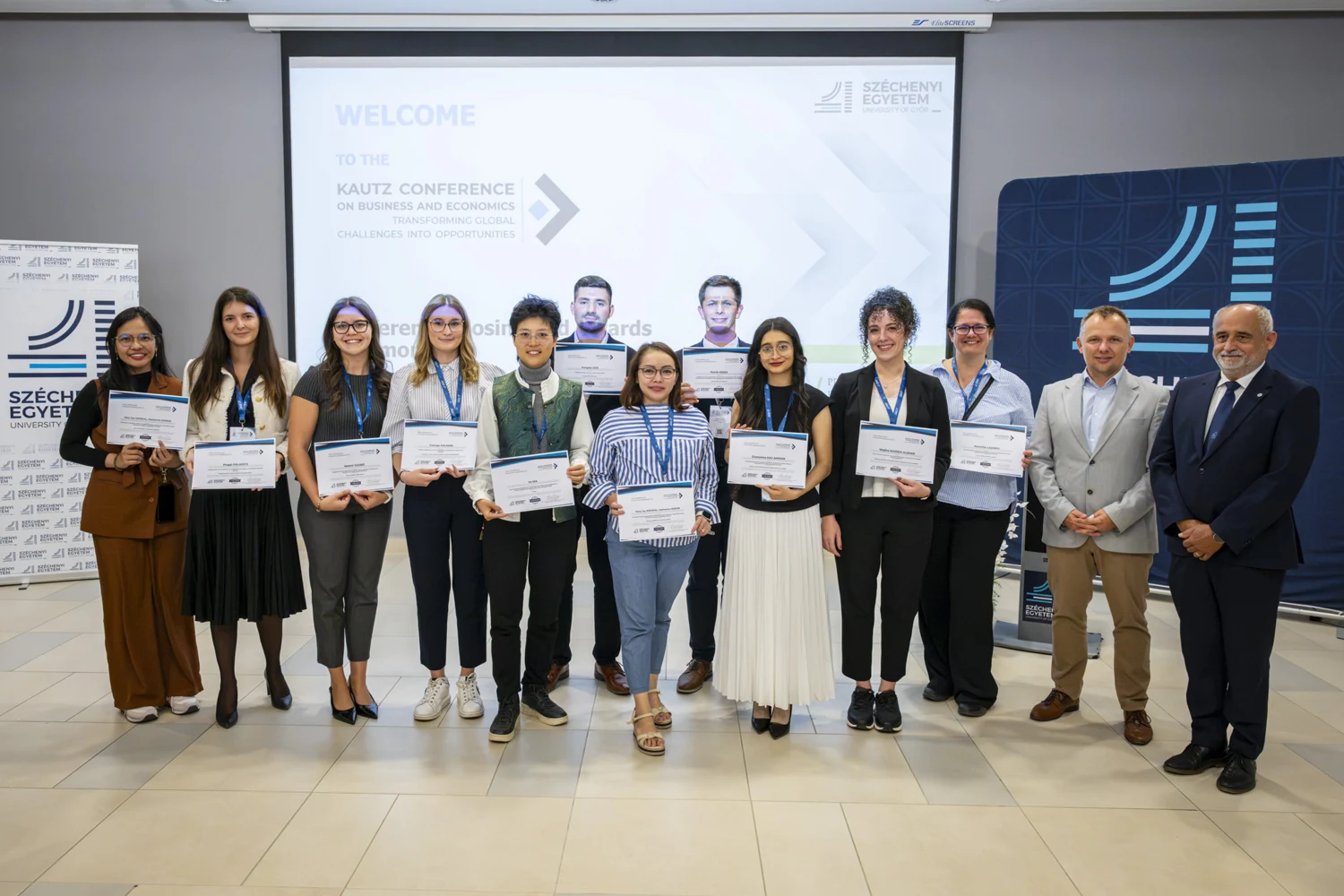
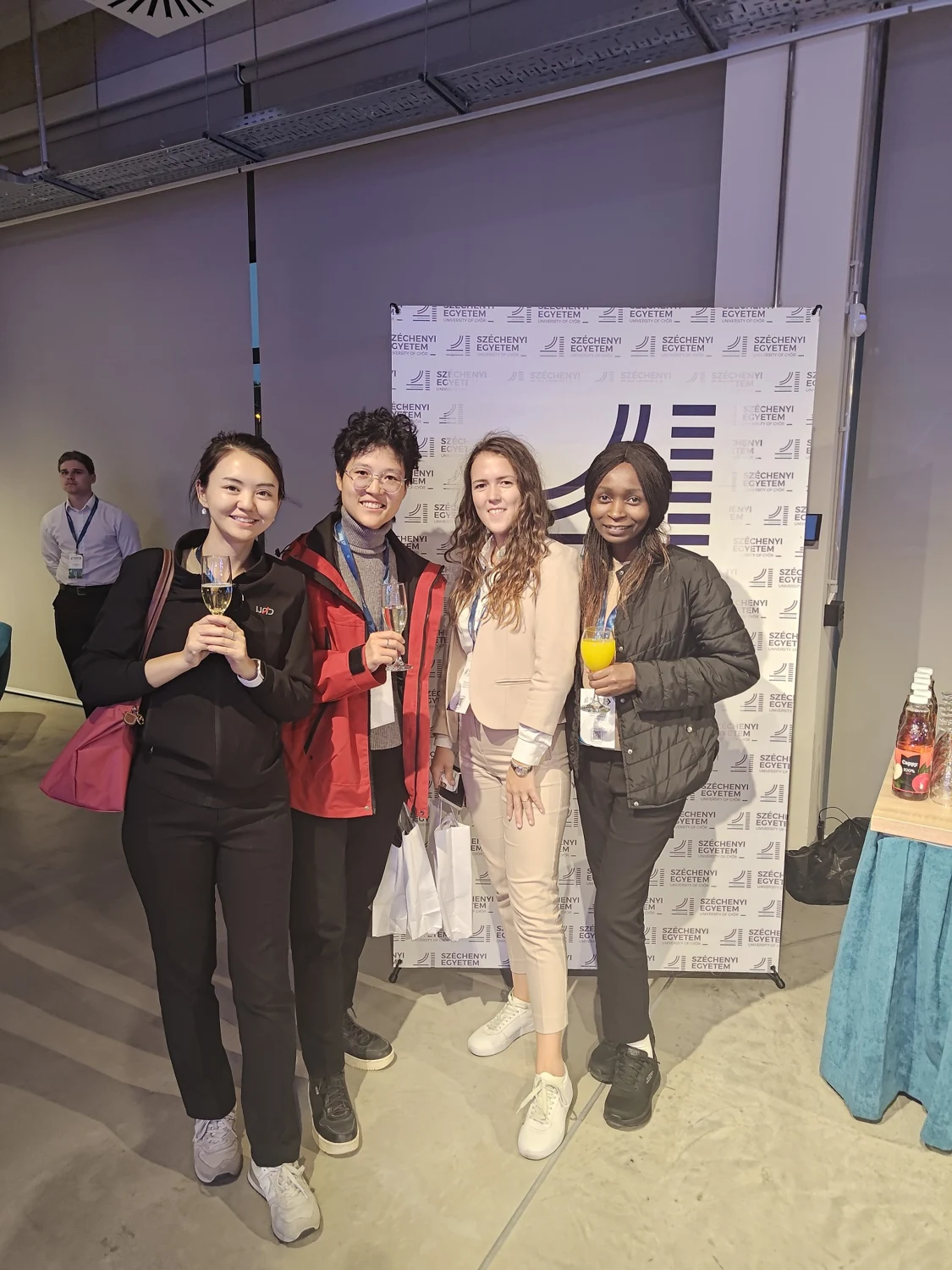
Ma Ye and other recognised conference participants holding certificates
Photo: Dudás Máté
RESEARCH EXCHANGE · FOUNDER RECOGNITION

Kautz 2026 | Research presentation award & international exchange

MY CREATIVE CENTER founder and Mgreen Lab researcher Ma Ye received the Best Presenting Author Award for research on AI, patent text and green technology embedment in product design, alongside international academic exchange.

Explore the award & conference exchange

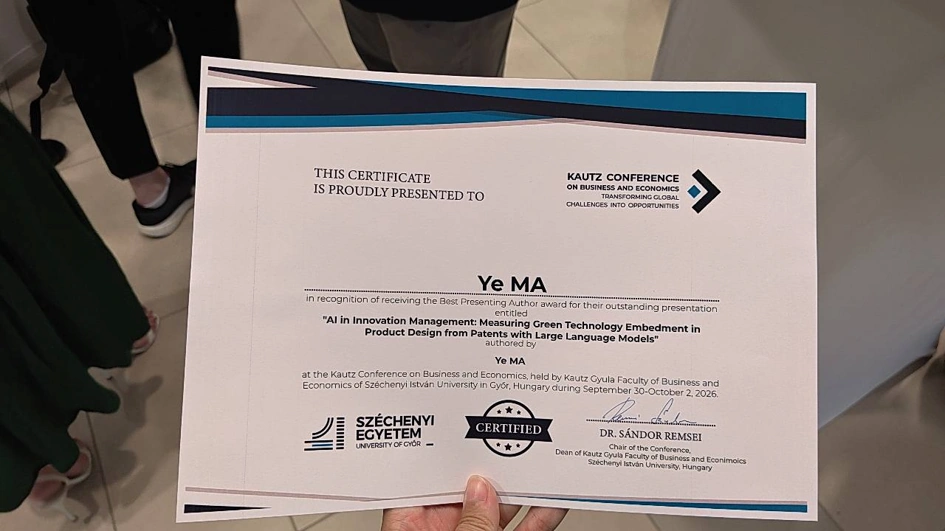
From September 30 to October 2, 2026, MY CREATIVE CENTER founder and Mgreen Lab researcher Ma Ye attended the Kautz Conference on Business and Economics in Győr, Hungary, and received the Best Presenting Author Award.

The awarded presentation was entitled “AI in Innovation Management: Measuring Green Technology Embedment in Product Design from Patents with Large Language Models”. It explored using large language models to analyse patent text and measure how green technology is embedded in product design. The certificate was issued in the name Ye MA.

Ma Ye received this recognition as the presenting author. The research topic connects with the company’s interests in AI, product design and green innovation, while documenting the founder’s continuing engagement in international research exchange.

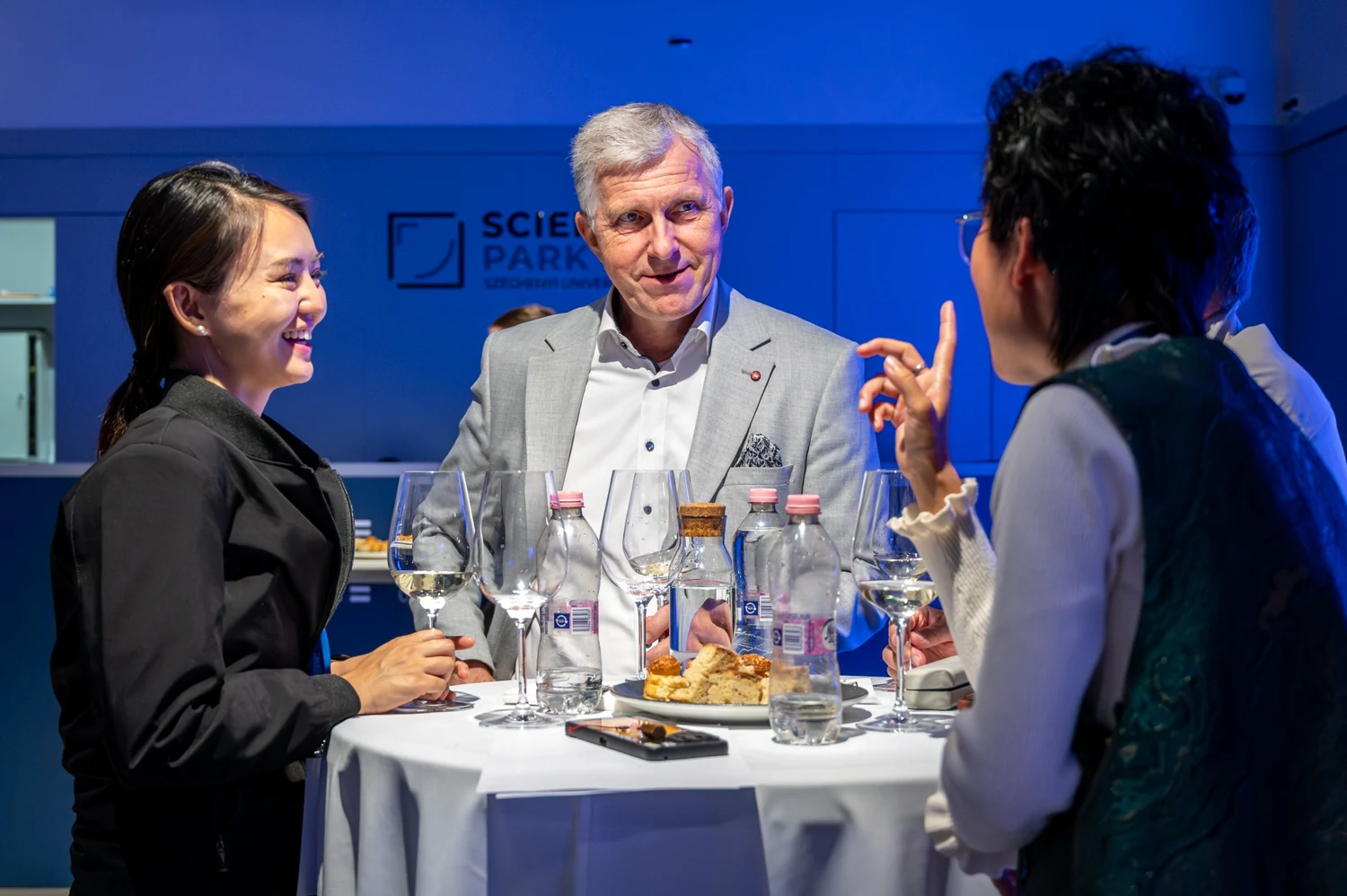
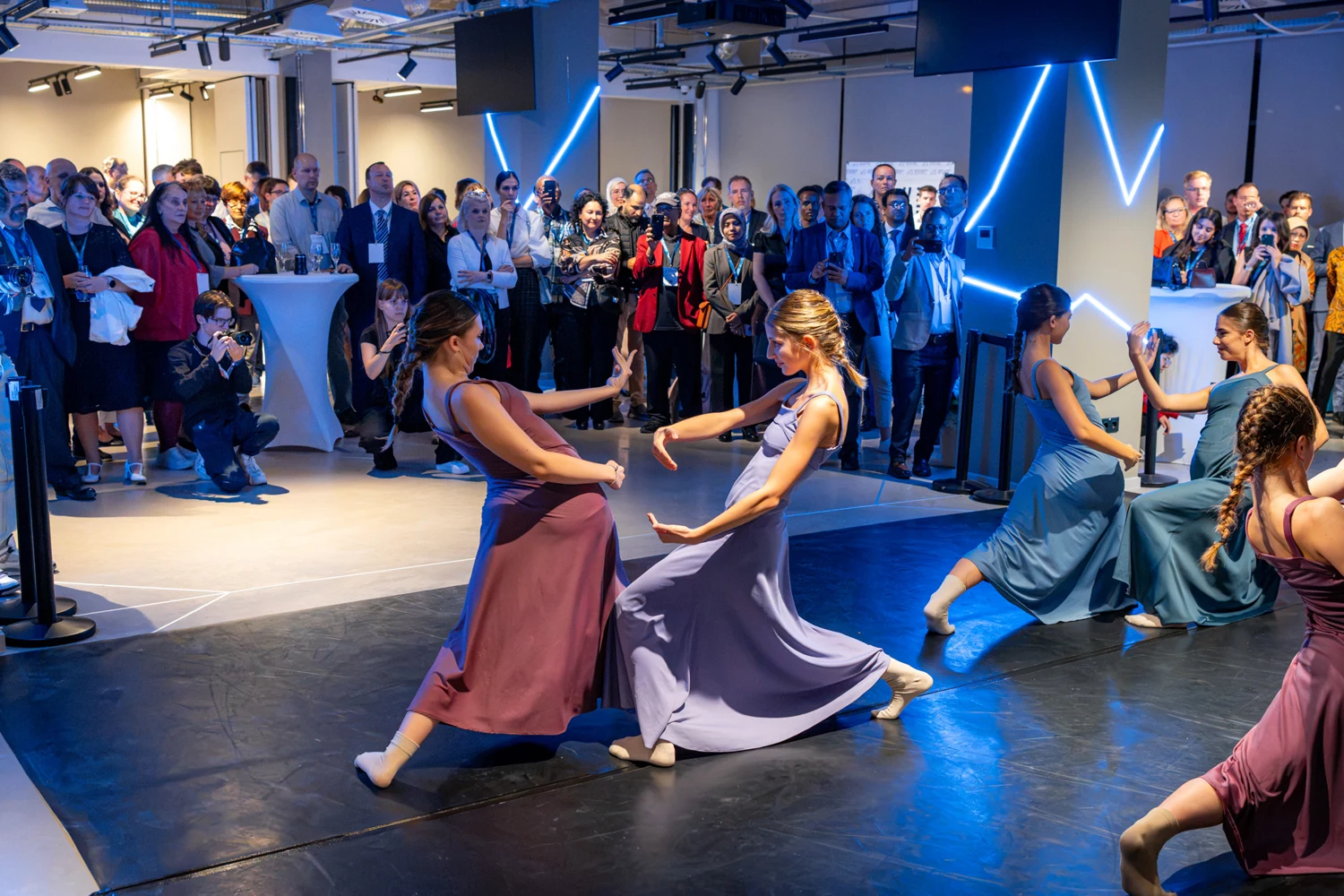
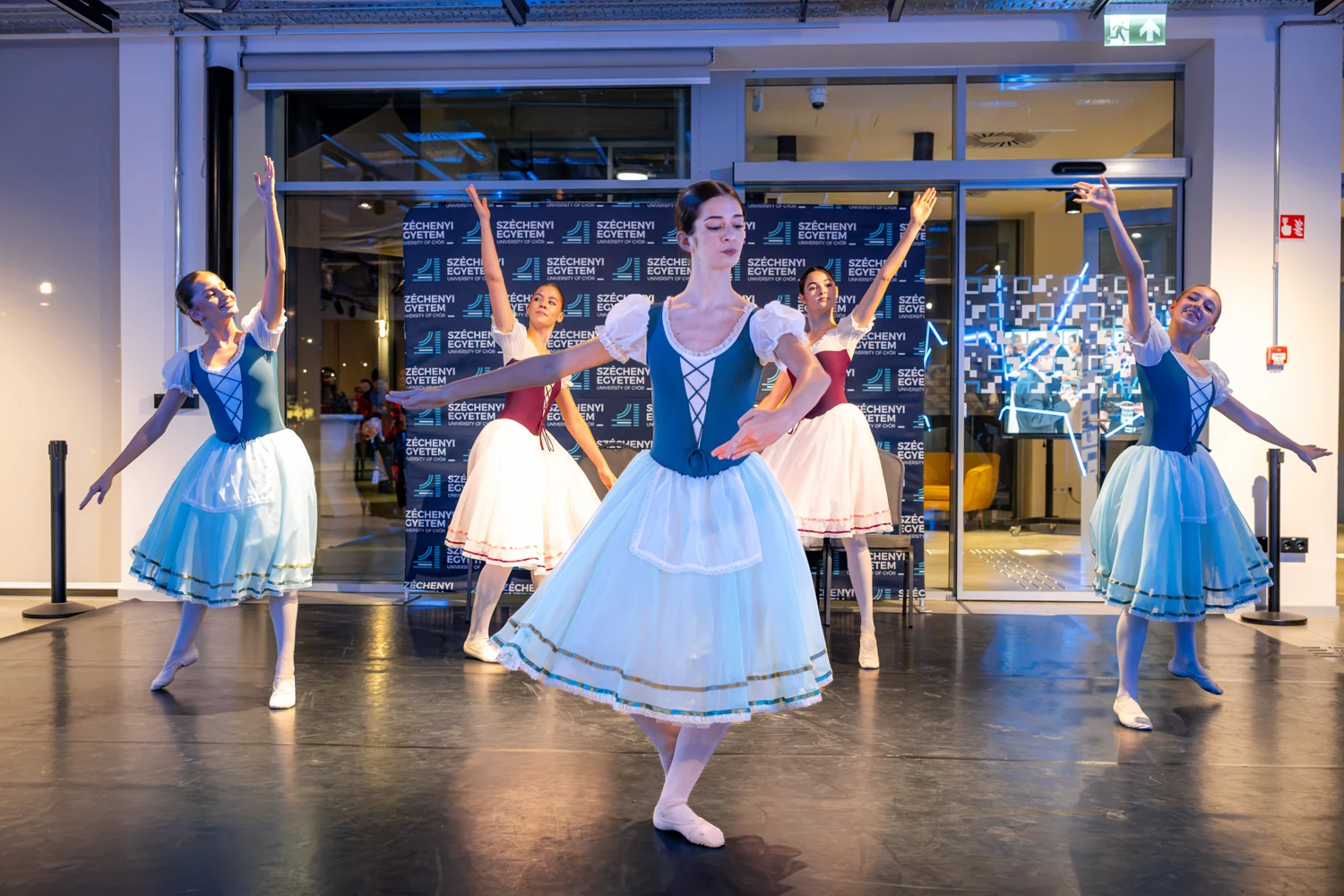
Beyond the conference sessions, the reception and dinner offered an informal setting for conversation. Ma Ye joined discussions and social activities, encountering different backgrounds and perspectives through cross-cultural exchange.

From research presentation to international exchange, participation adds a concrete record of the company’s connection between research and practice. Green technology, AI and product design management remain areas of research and exploration for the company.

Read about Ma Ye’s conference research presentation ↗

Conference website

Open article ↗
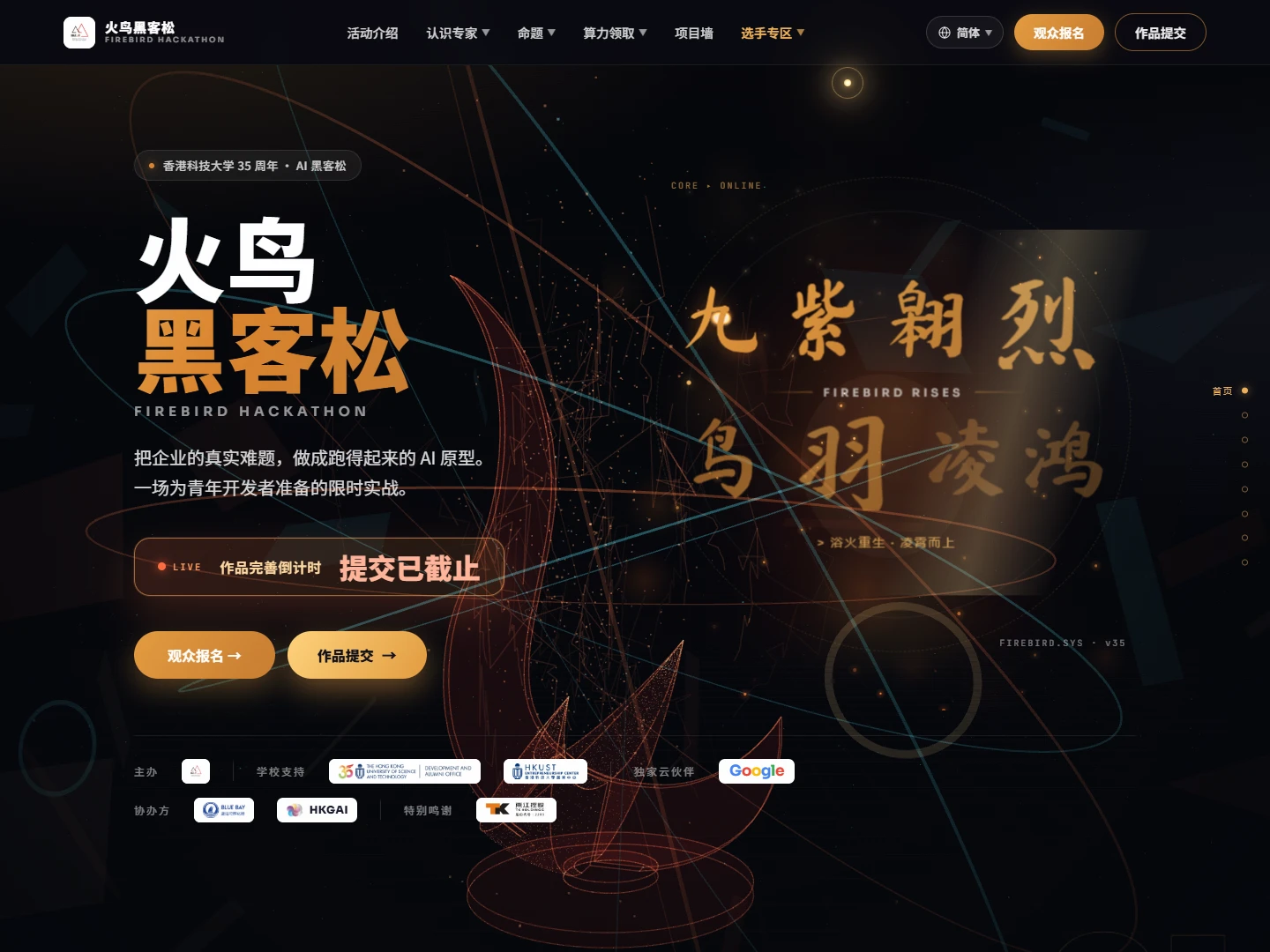
Actual Firebird Hackathon homepage: navigation, Firebird visuals and project submission entry
Firebird Hackathon · website screenshot
DIGITAL PRODUCT · INNOVATION EVENT

Firebird Hackathon | From event identity to digital infrastructure

MY CREATIVE CENTER designed and developed the complete Firebird Hackathon website, connecting immersive branding, project delivery, judging and event operations. The HKUST 35th-anniversary event brought together 104 teams and more than 200 participants from nine countries and regions.

Explore the architecture & project

A hackathon needs more than an event brochure. Participants need to understand industry challenges, follow the schedule, organise teams and submit work. Organisers need these steps to connect through a shared digital entry point. We delivered visual design, interaction development and API integration around the actual event journey.

Our scope covered the complete website design and development: information architecture, event visuals, responsive interfaces, motion, progress reporting, submissions, file storage, project presentation, judge assignment, score aggregation and voting. The frontend works with Cloudflare Workers, D1, R2 and Workers AI to connect participant experiences with the organising team’s daily operations.

This project expresses our approach to digital product design: information, behaviour and systems belong together. Technology creates visual impact while clarifying complex workflows, making large-file delivery visible and preserving usability across devices.

SYSTEM FLOW

  1. React frontend & real-time interaction
  2. Workers business API
  3. D1 data & R2 files
  4. Judging, operations & AI translation

01 / Frontend architecture: shared state for presentation and workflows

The interface uses React 18.3.1 with the DCLogic template runtime. Templates mount as React components, with state / setState driving form fields, view changes and feedback. URL hashes locate views such as challenges and submissions, connecting the event narrative with ongoing participant tasks.

UI runtime
React / ReactDOM 18.3.1 · DCLogic
Views & preferences
Hash-based view selection · language preference in localStorage

02 / Real-time visuals: particle systems and WebGL

The Firebird scene uses Three.js for real-time particles, with BufferGeometry, typed arrays and custom particle attributes organising the scene data. Shader-driven visuals and an EffectComposer / UnrealBloomPass bloom pipeline extend the brand into a dynamic scene. The configured scene combines 22,000 primary sampled particles and 460 embers to give the event identity a sense of spatial depth.

Rendering engine
Three.js 0.128.0 · WebGL
Scene composition
22,000 primary sampled particles + 460 ember particles
Post-processing
EffectComposer · UnrealBloomPass bloom

03 / Motion orchestration: scrolling as part of the experience

GSAP and ScrollTrigger tie typography, sections and parallax to scroll progress. Lenis supplies smooth scrolling and synchronises ScrollTrigger updates. IntersectionObserver triggers viewport reveals and count-up effects, coordinating large-scale scenes with local feedback.

Scroll animation
GSAP / ScrollTrigger 3.12.5
Smooth scrolling
Lenis 1.0.42 · synchronised scroll events
Accessibility
Respects the prefers-reduced-motion preference

04 / Rendering budget: resource constraints in the implementation

The scene caps pixel density and monitors frame time. Persistent slow frames disable bloom while retaining the base scene, and scene updates are skipped when the page is hidden. A static Canvas 2D drawing path is also included. These choices put resource awareness into the rendering logic, adapting visual effects to device conditions and page visibility.

Pixel ratio cap
devicePixelRatio capped at 1.4
Adaptive post-processing
Accumulated frames above 42 ms trigger bloom disablement

05 / API separation: interface and business services

A JavaScript Worker handles requests through its Fetch entry point, routing event operations by HTTP method and path. The production domain supports same-origin /api routing. JSON APIs serve frontend submissions and data retrieval, Worker-generated HTML serves administrative views, and CSV responses support exports. Interface interactions, data operations and event administration share one backend implementation.

Runtime & protocols
Cloudflare Workers · Fetch API · HTTPS
Interfaces & outputs
Same-origin API · JSON · server-rendered HTML · CSV

06 / Data architecture: event state and project records

Cloudflare D1 stores structured event data for submissions, progress, judges, assignments, scores, public curation, votes and test flags. The Worker uses prepare / bind for parameterised SQL. R2 stores file contents while D1 stores their object keys. Resubmissions retain submission identifiers and history, preserve earlier values for blank fields and restrict which material fields may be updated, keeping project updates connected to judging references.

Structured data layer
Cloudflare D1 · parameterised SQL
Data / file separation
D1 stores metadata and object keys · R2 stores files
Resubmission handling
Retained project ID · material-field updates · history reconciliation

07 / File architecture: R2 signed uploads and temporary access

Cloudflare R2 stores project files. The Worker validates signing requests using team, project, material kind, filename and declared size, then implements AWS Signature V4 with Web Crypto SHA-256 / HMAC to generate S3-compatible temporary upload URLs. The browser uploads directly to R2 via XMLHttpRequest PUT, then submits object keys and project metadata to D1. Downloads also use time-limited signatures, separating transfer, business records and access authorisation.

Object storage & signing
Cloudflare R2 · S3-compatible API · AWS Signature V4
Upload signature lifetime
3,600 seconds / 60 minutes
Upload flow
Request signature → PUT upload to R2 → file references in D1
Transfer feedback & validation
Progress, speed and ETA · file-kind and declared-size validation

08 / Judging and operations: assignments to ranking views

Judge-to-project assignments are stored in a mapping table and configured through an administrative matrix. The Worker writes assignments to D1 in batches of 40. Scores are organised by round, judge and project, with ON CONFLICT updates for dimensions, total scores, notes and timestamps to support repeated saves. Administrative features include publication controls, finalist flags, awards and cover management, progress summaries, rankings, participant-list preparation and CSV exports.

Score record key
Round × judge × project · ON CONFLICT updates
Assignment writes
D1 batch · 40 records per batch
Operational outputs
Project curation · ranking views · CSV exports

09 / Access and consistency: server-side rules

Administrative views use HTTP Basic authentication, with configuration such as the administrator password held in Cloudflare Secrets. Judging validates judge codes and supports an additional password check. Voting enforces the deadline server-side and uses hashed identifiers, composite database keys and a per-network, per-project time-window limit to handle repeated records. Historical votes are reconciled after project updates to keep the public presentation connected to the project record.

Identity & configuration
Admin authentication · judge-code validation · Cloudflare Secrets
Vote record handling
SHA-256 identifiers · composite keys · server-side deadline and frequency checks

10 / AI and languages: cross-regional judging and exchange

The interface supports Simplified Chinese, Traditional Chinese and English, persisting the language preference in localStorage. Server-side translation handles dynamic project descriptions and judging content. The source configures Cloudflare Workers AI’s @cf/meta/m2m100-1.2b model for Chinese-to-English translation and includes an optional Google Cloud Translation adapter. The current deployment has a confirmed Workers AI binding. Translation assists understanding across regions.

Interface languages
Simplified Chinese · Traditional Chinese · English
AI translation configuration
Workers AI · @cf/meta/m2m100-1.2b
Application context
Dynamic project descriptions · Chinese / English judging support

Organisational involvement and project significance

Founder Ma Ye participated in preparing and organising the event as an HKUST alumnus, Vice-President of the HKUST Mainland Alumni Association and Co-Chair of the organising committee. MY CREATIVE CENTER translated innovation-community needs into an interactive system for participation, submissions and collaboration—a concrete example of our work connecting design, technology and innovation practice.

Visit the Firebird Hackathon website ↗

Event scale and organising roles: official HKUST recap

Open article ↗
Brand management handbook cover
Original handbook page · Brand management handbook cover
BRAND DESIGN · EARLY COLLABORATION

HKUST(GZ) | Committee identities & brand handbook

MY CREATIVE CENTER designed the complete identities and brand handbook for two committees at HKUST(GZ)’s College of Future Technology, connecting multilingual logos with colour, typography and stationery standards.

Explore the identities & brand standards

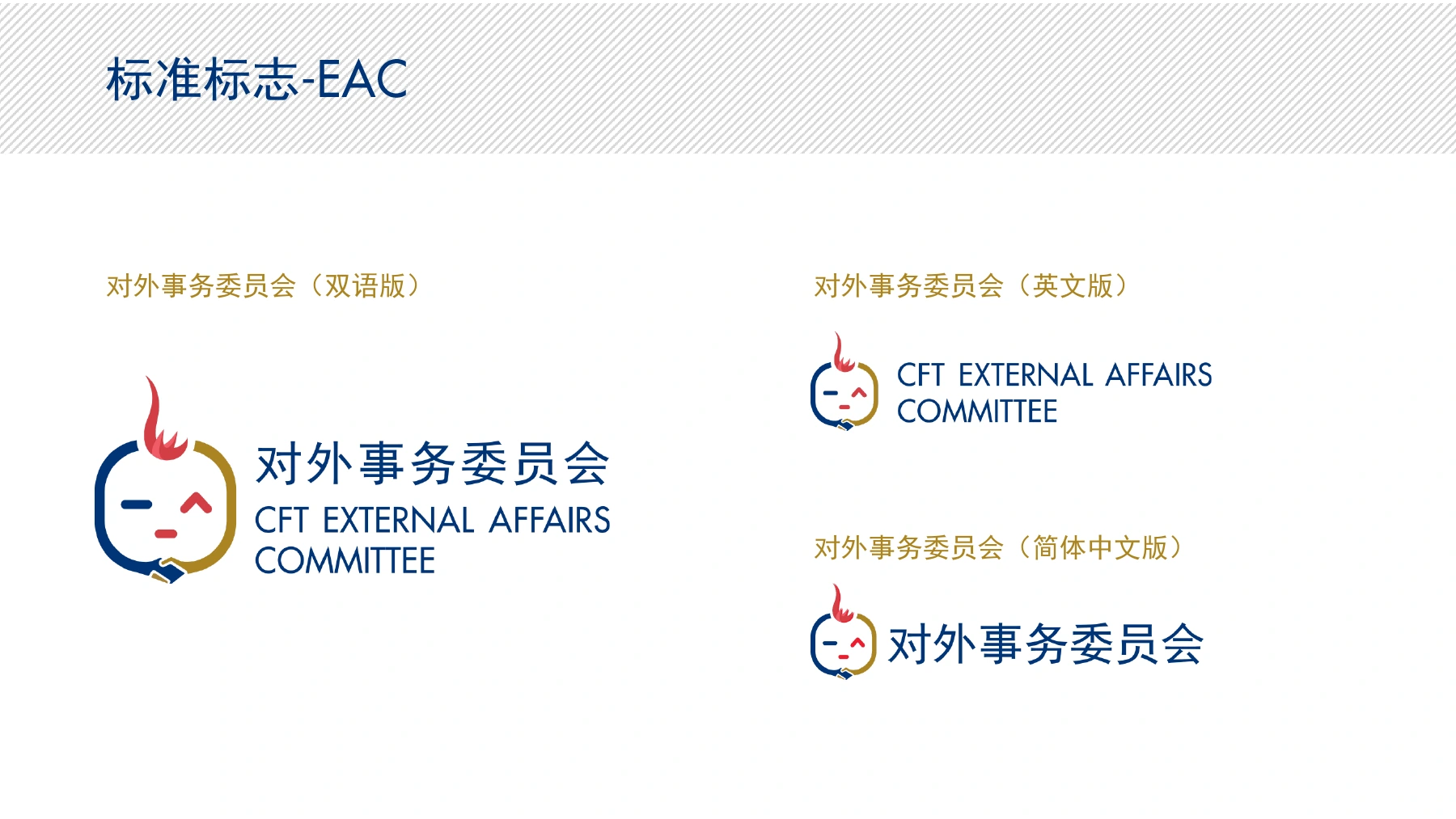
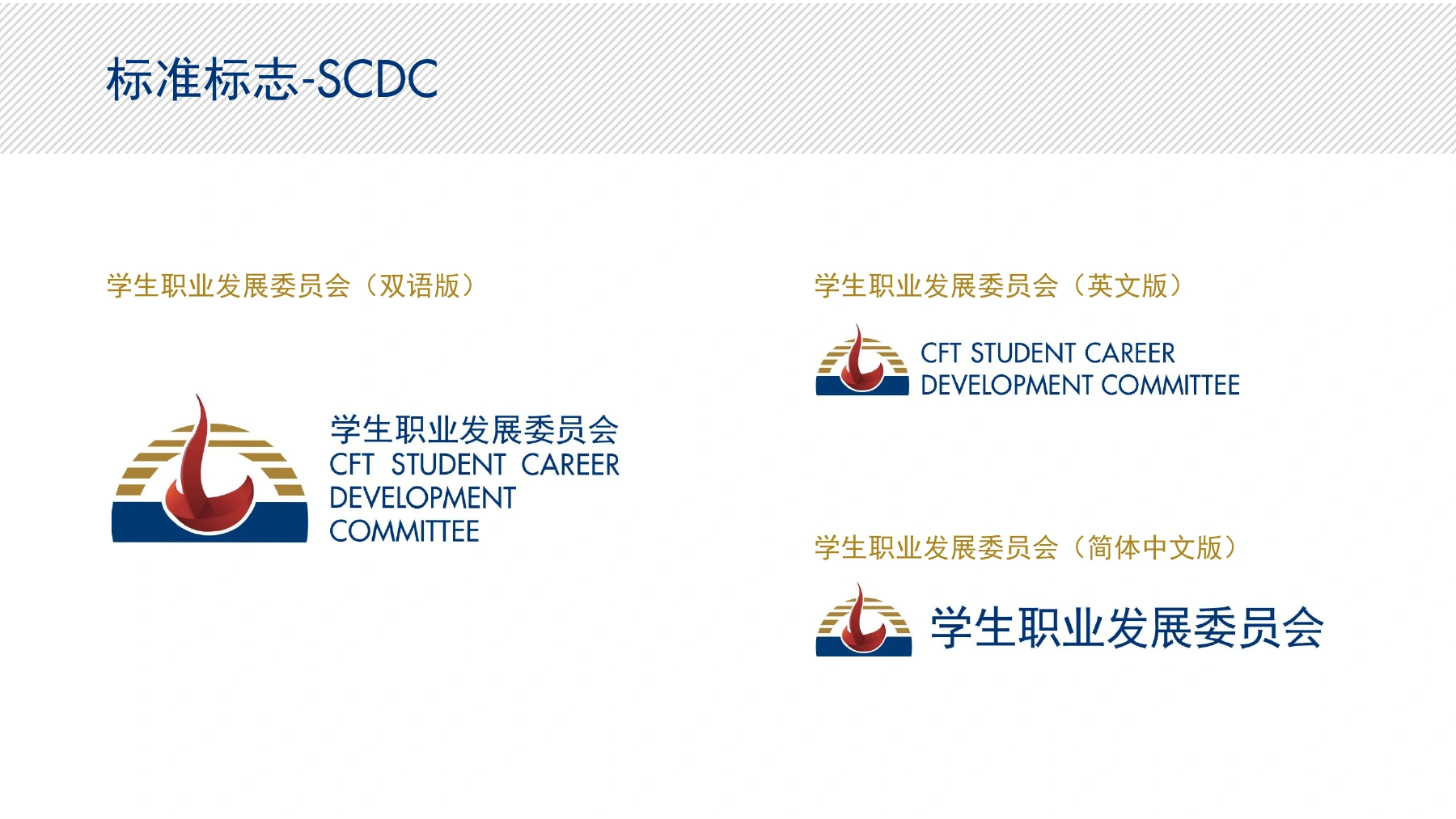
An early MY CREATIVE CENTER collaboration, this project delivered the complete visual identities and brand handbook for the External Affairs Committee (EAC) and Student Career Development Committee (SCDC) at the College of Future Technology, The Hong Kong University of Science and Technology (Guangzhou).

The design translates the committees’ different missions into distinctive visual identities while incorporating elements from the Red Bird sundial and university identity to maintain a connection with the institution.

Deliverables include the logos, design concepts, element construction, language variants, university co-branding rules, typography, colour specifications and applications for envelopes, letterheads and business cards.

The 17-page handbook carries February 2024 on its cover and a March 2024 version note on its final page. The images in this case are original pages from the project handbook.

Two missions, two distinctive visual identities

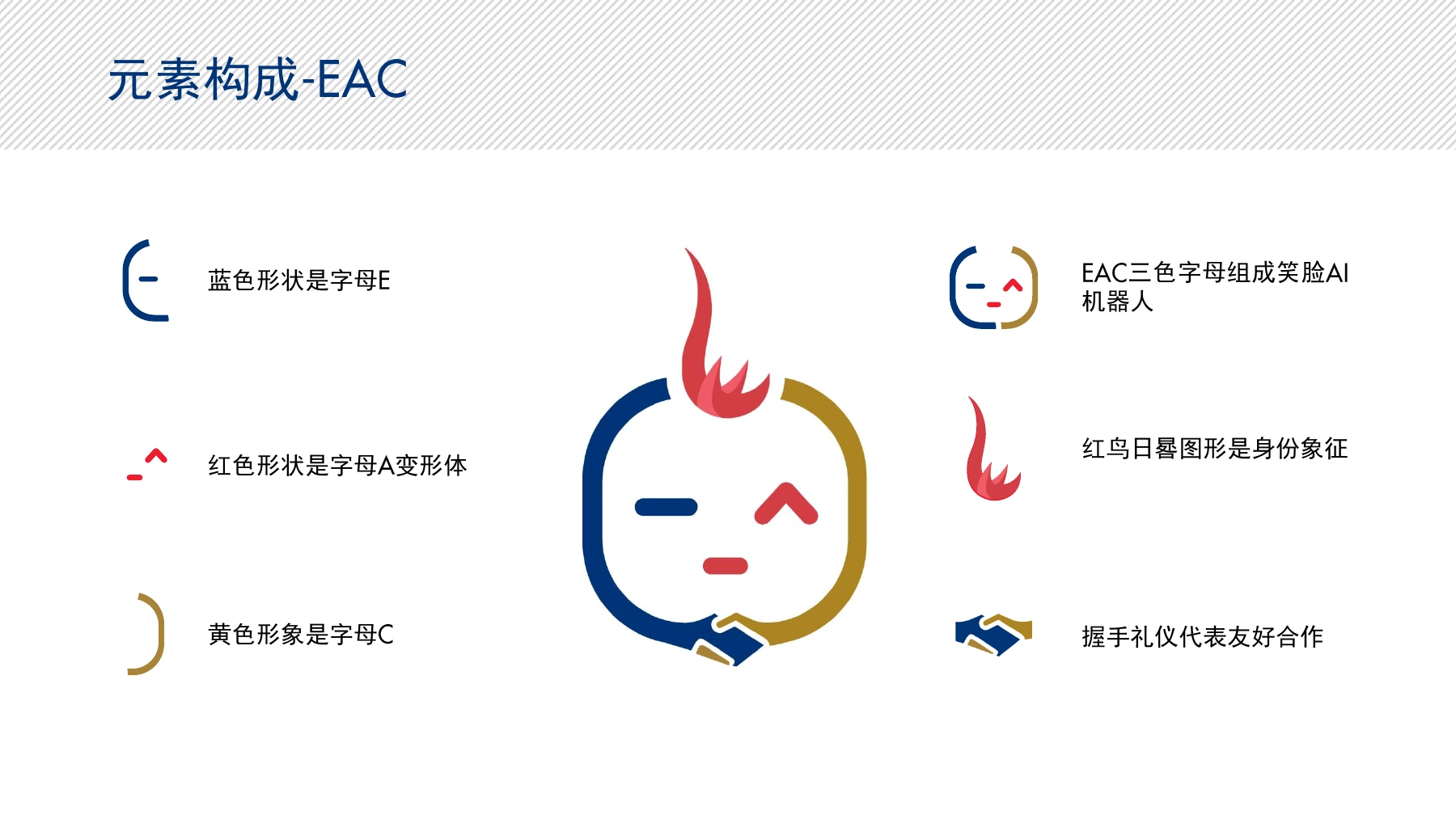
The EAC identity transforms E, A and C into a blue, red and gold robot face. The Red Bird connects it to the university, the smile conveys friendliness, equality, respect and patience, and the handshake detail represents dialogue and collaboration.

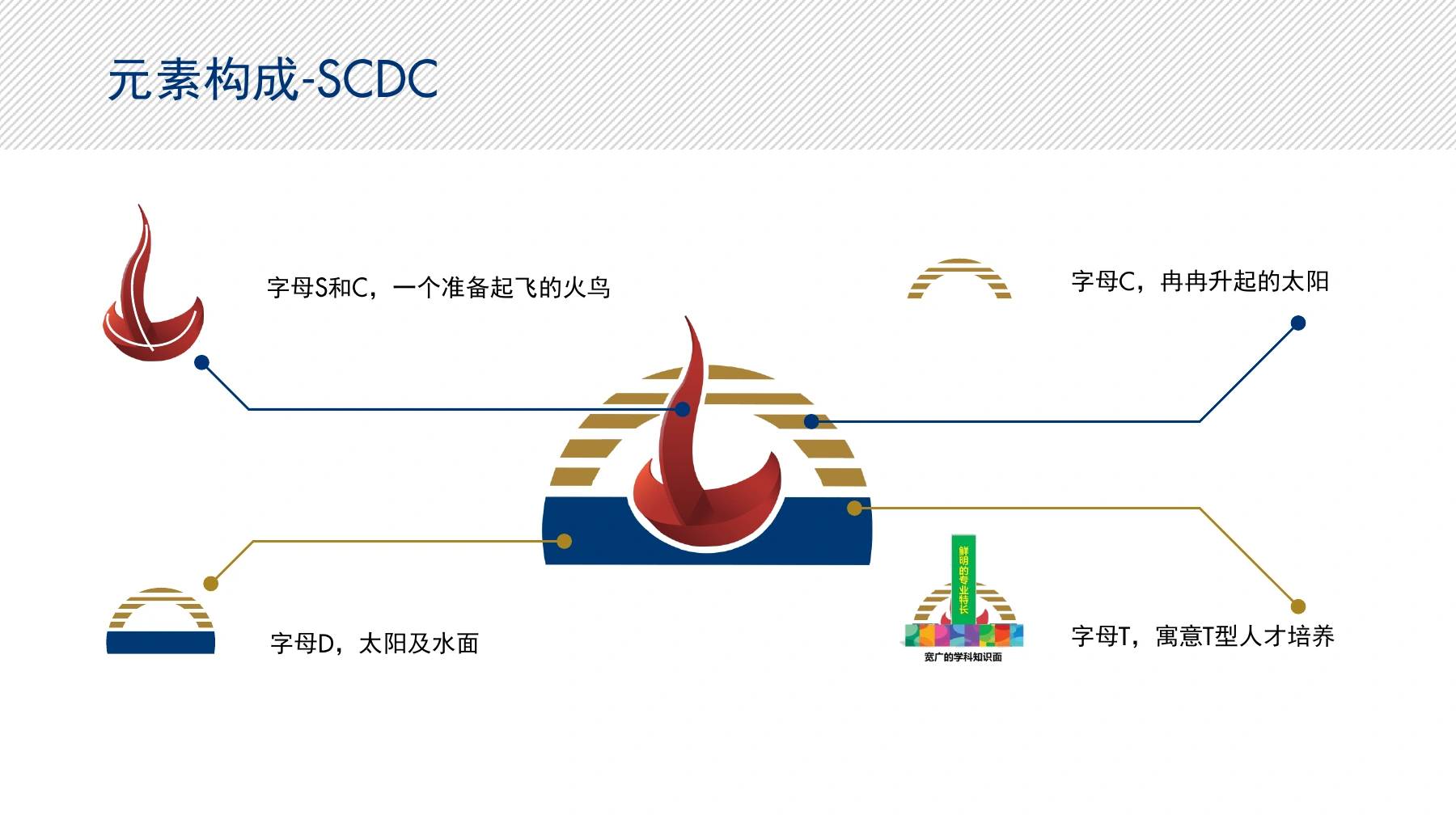
The SCDC identity combines a Red Bird preparing for flight with a rising sun and water, incorporating the relationships between S, C, D and C. Its concept connects student growth, learning and future career development.

Identity systems
EAC — External Affairs Committee; SCDC — Student Career Development Committee
Language variants
Bilingual, English and Simplified Chinese versions for each identity

From identities to usable brand standards

The handbook defines placement, spacing and combinations when committee identities appear with the university logo, referencing the university brand guidelines to support consistent application.

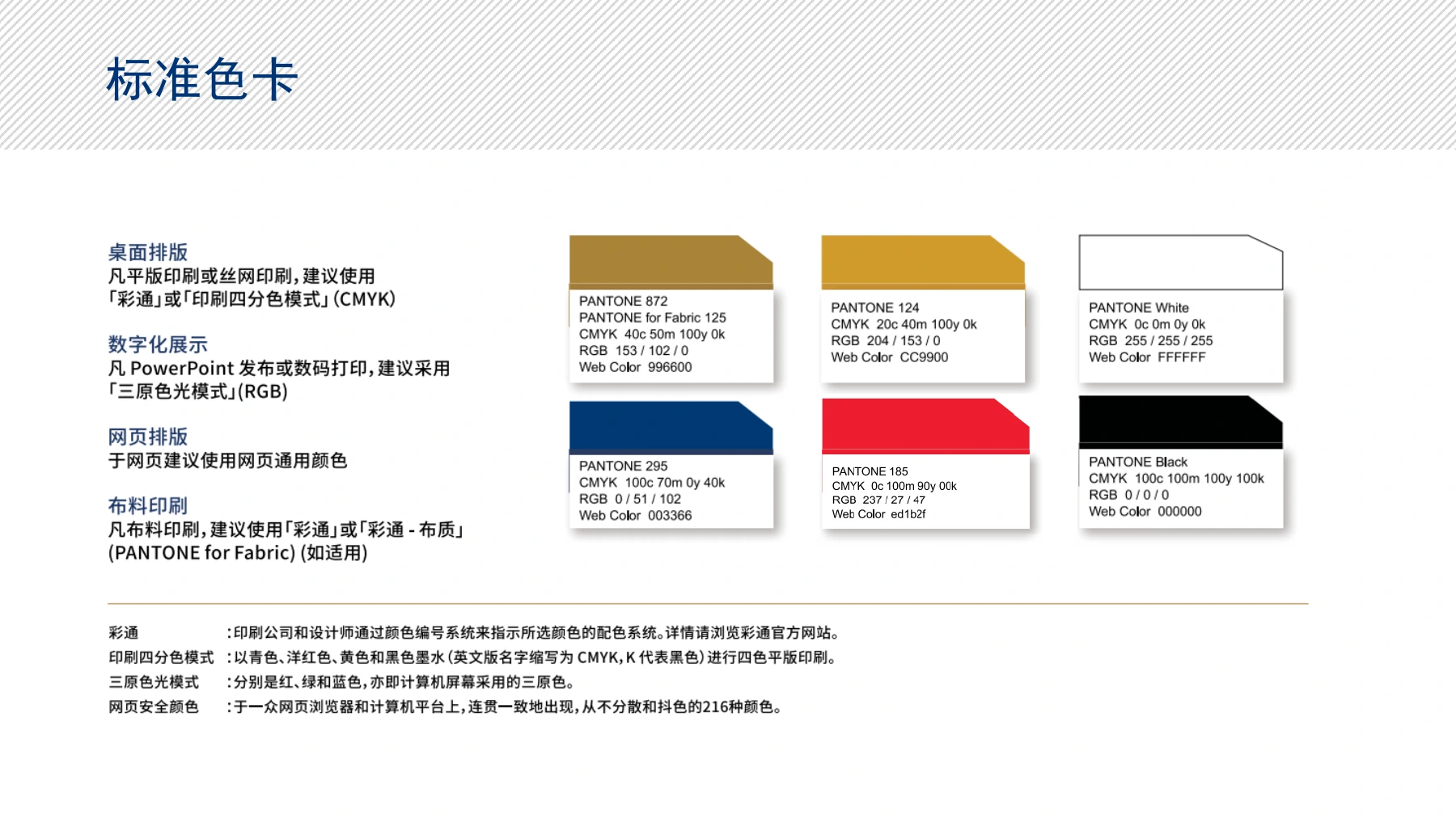
Typography uses Futura Medium for English and Heiti for Chinese. Colour guidance distinguishes CMYK printing, RGB digital display, web colours and fabric printing.

Document deliverable
17-page brand management handbook; 2024 version
Typography
English: Futura Medium; Chinese: Heiti
Colour system
Pantone 872, 124, 295 and 185; white and black; CMYK / RGB / web specifications
Co-branding
Placement and spacing for university, college and committee identities

Bringing the identity into everyday use

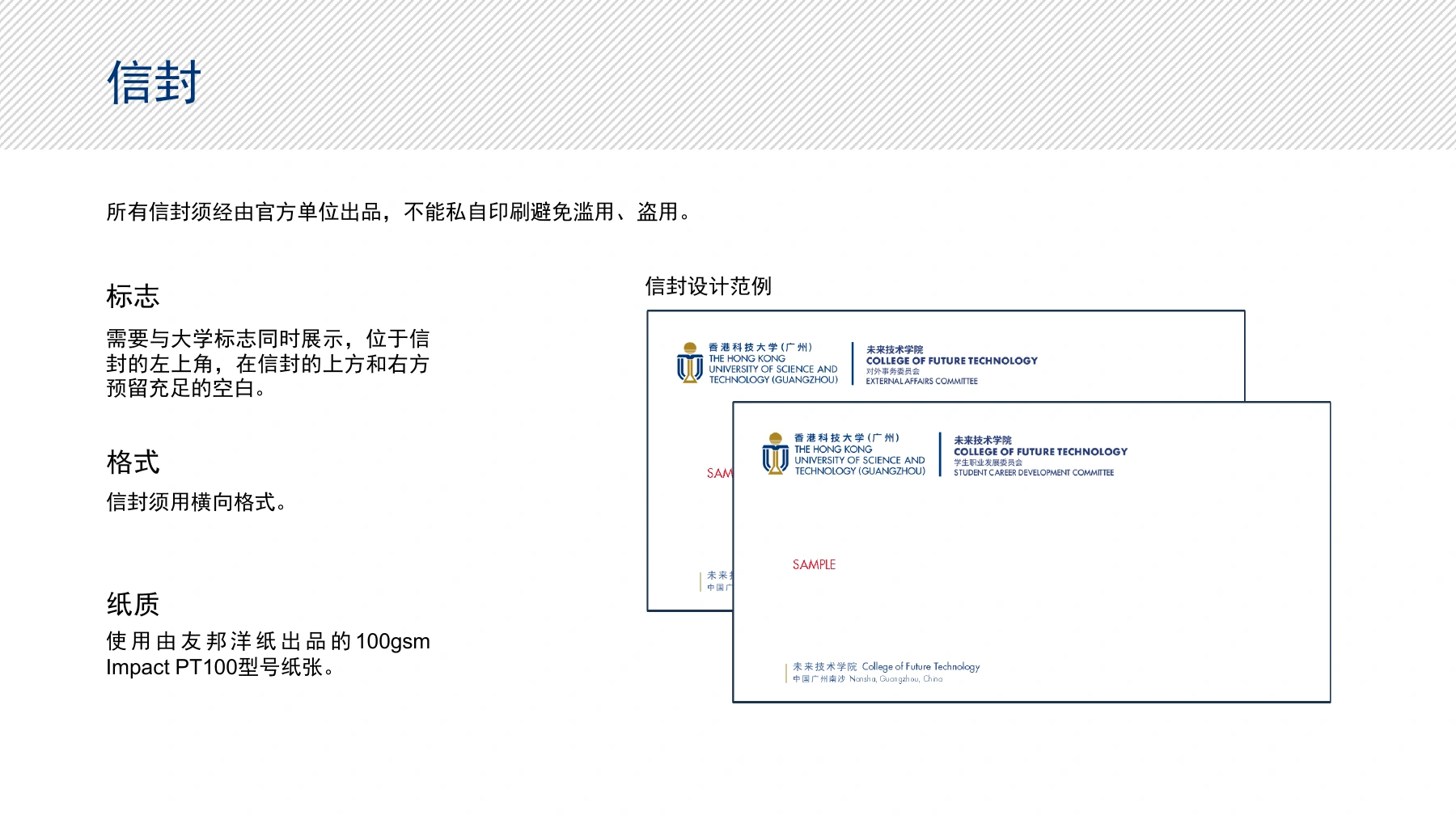
Envelope, letterhead and business-card layouts translate the identity rules into daily communication, specifying logo placement, information hierarchy, dimensions and paper choices.

This early project demonstrates the company’s ability to translate an organisation’s mission into a visual language and organise that language into a usable design system. Together with the later Firebird Hackathon brand experience and website development, it shows a practice spanning identity and digital products.

Letterhead
A4 portrait; 100 gsm Impact PT100 paper
Envelope
Landscape format; 100 gsm Impact PT100 paper
Business cards
90 × 50 mm; 270 gsm Coronado sst CR682SS bright white, smooth paper
Company scope
Complete logo design, visual standards and brand handbook
Open article ↗
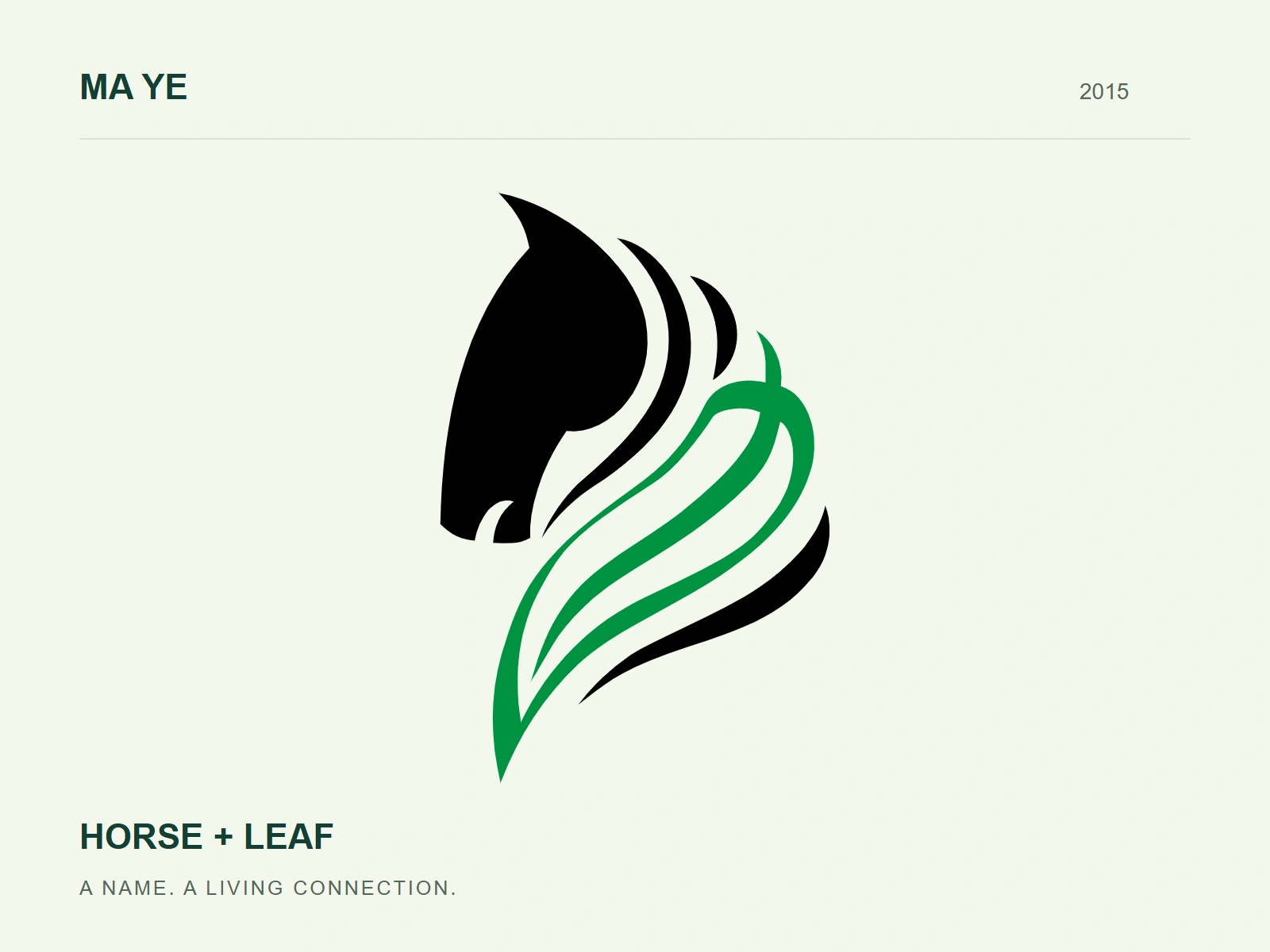
Ma Ye’s black horse profile and green leaf identity, designed in 2015
Original 2015 mark · case presentation
PERSONAL IDENTITY · DESIGN INTERPRETATION

Ma Ye | Horse & leaf personal identity

Designed in 2015, Ma Ye’s personal mark brings together a horse (ma) and a leaf (ye) to give her name a visual form. Animal and plant meet in one identity, connecting agency, growth and the relationship between people and nature.

Explore the name, form & ecological meaning

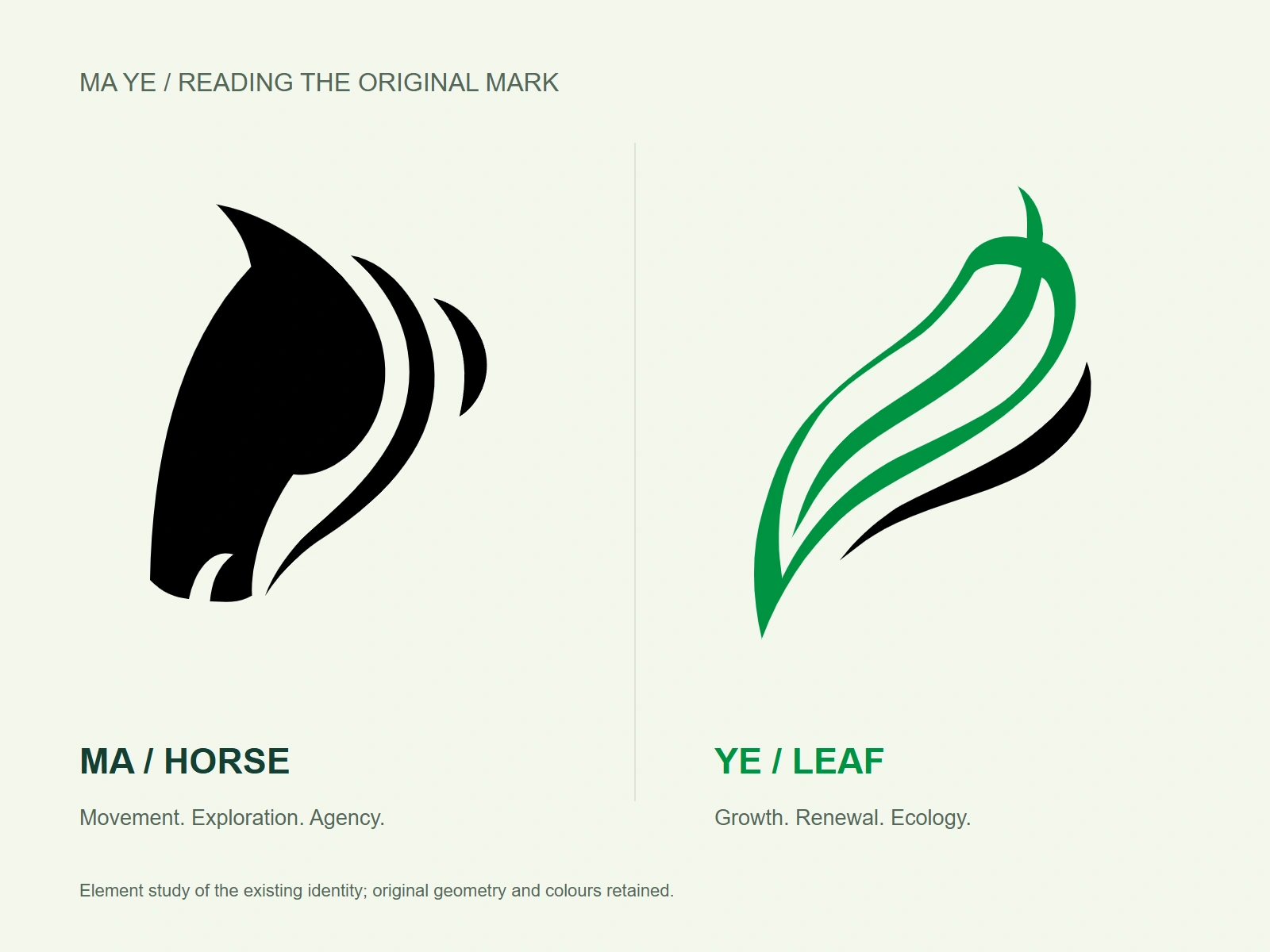
Designed in 2015, this personal identity combines a horse profile and a green leaf. Ma is both the Chinese word for horse and Ma Ye’s surname. Ye means leaf and shares its pronunciation with 烨, the character in her given name. The two natural forms together give Ma Ye a visual identity.

The mark connects a name, a form and a set of values. The horse carries associations of agency and exploration; the leaf suggests growth and renewal. Their combination places an individual identity within a wider living system.

This case reads the name, form, colour and ecological relationships, extending their meaning from a present-day brand perspective. It brings the 2015 design together with the interpretation developed here.

A name becomes a form: horse / Ma, leaf / Ye

Ma aligns a surname with a recognisable animal. The leaf connects to the given name through the shared sound ye. Sound becomes the bridge and natural forms become the language for translating a name.

A viewer can recognise horse and leaf before discovering Ma Ye, moving from image to name to meaning. Chinese meaning and pronunciation connect with the Romanised name in a single mark.

Designed
2015
Name correspondence
Ma: surname and horse; Ye: leaf, pronounced like 烨 in the given name

Agency and growth: complementary living forces

The horse can be read as agency, independence and exploration: putting judgment into action, entering unfamiliar territory and finding direction through practice. It gives the mark an active, determined character.

The leaf can be read as vitality, learning and renewal: drawing nourishment from its surroundings, responding to changing conditions and continuing to grow. It adds patience, adaptability and a long-term perspective to action.

Together they suggest exploring through action and responding through growth. Research, design and entrepreneurship require this rhythm: the initiative to begin and the willingness to learn from feedback.

Animal and plant: an identity within an ecology

Animals and plants exist through relationships within living systems. The meeting of horse and leaf can symbolise the interdependence of people and nature, and a wish for individuals and their environments to grow together.

This extends green into a way of examining a question: understanding the setting of an action, attending to the resources and relationships involved in creating value, and considering its longer-term effects.

Viewed today, this ecological narrative resonates with MY CREATIVE CENTER and Mgreen Lab’s interest in green innovation and product design: considering human needs, business value and environmental relationships together when exploring technology and products.

Form and colour: connection through flow

The solid horse profile and its outward curves echo the leaf contour and veins. Continuing arcs and negative space organise the two forms into a whole, giving the identity a flowing, open rhythm.

Black creates a clear silhouette and visual anchor, inviting a reading of independent judgment and purposeful action. Green highlights the leaf’s vitality, suggesting renewal, growth and ecological awareness. Their contrast supports recognition.

The existing artwork is stored as SVG vector paths, and the website also uses a white monochrome version. This case retains the original forms and colours while using presentation and element studies to explain their meaning.

Original colours
Black #000000; green #009242
Artwork
Original SVG vector artwork; existing white monochrome website version

Brand value: a name that becomes a lasting visual language

The name supplies an identity cue, horse and leaf supply visual memory, and agency and growth supply a value narrative. Together, these layers support consistent recognition across personal introductions, research exchange and entrepreneurial expression.

The mark also illustrates an approach to brand design: beginning with a real name and experience, then finding a visual language that can be seen, remembered and explained. A simple form carries several meanings, while continued use allows those meanings to accumulate.

A concise reading: act with the horse’s agency; grow with the leaf’s vitality; remain connected to the world that sustains both.

Open article ↗

MGREEN LAB / INSIGHTS

Research for product practice

Mgreen Lab is the internal research practice of MY CREATIVE CENTER. These insights inform AI applications, workflows and digital products. Choose All research to explore our broader knowledge base, including green technology.

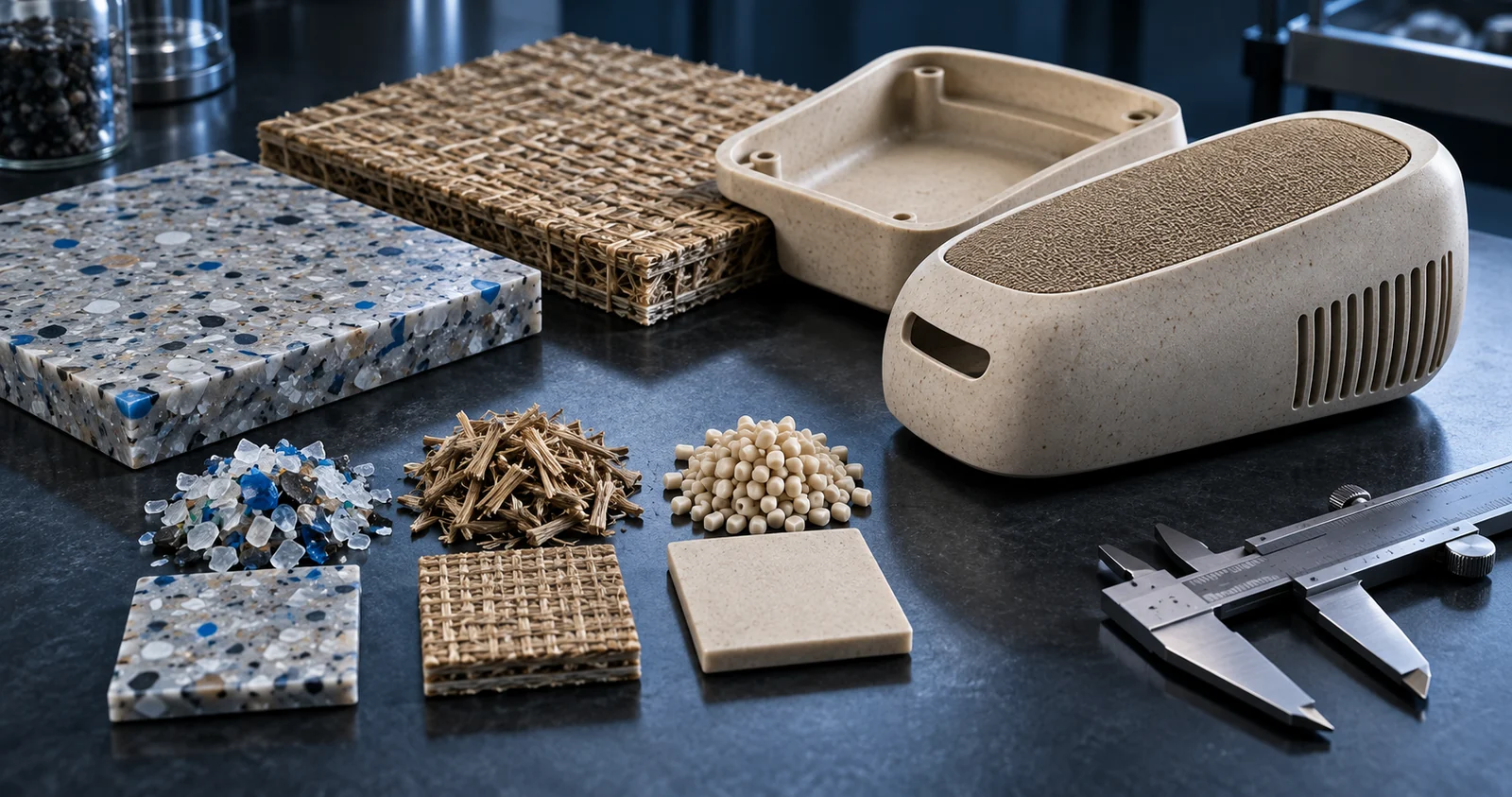
AI concept illustration of material specimens, recycled feedstock and a finished moulded housing
RESEARCH INSIGHT

Green materials: what will customers actually pay for?

Use a sustainable-fashion experiment and LEGO’s material disclosures to separate environmental attributes, product experience and paid demand, then design a bounded market test.

Read the materials value study

A green material can support a purchase, but an environmental attribute does not establish a price premium. A stronger opportunity arises when it improves an experience, procurement requirement or lifetime cost that the buyer values—and that improvement can be substantiated.

Public sources checked on 24 October 2026. Research informs the mechanism and company disclosures illustrate implementation constraints. The proposed market test is Mgreen Lab’s editorial framework, not a reported client result.

Open article ↗
AI concept illustration of server racks, cooling circuits and external power infrastructure
RESEARCH INSIGHT

AI data centres: which electricity and water accounts matter?

Use IEA’s 2026 analysis and Microsoft’s cooling disclosure to separate demand from efficiency and on-site from power-sector water, with a practical project-accounting tool.

Read the data-centre resource study

Resource debates around AI data centres require three answers: how much is used, where and when, and who pays. A low PUE, zero cooling-water claim or global percentage alone cannot resolve a local community’s concerns.

Sources checked on 24 October 2026. Institutional estimates, projections, company design disclosures and illustrative scenarios are separated. No fixed water-per-AI-query conversion is offered.

Open article ↗
AI concept illustration of a disassembled phone, battery, enclosure and precision repair tool
RESEARCH INSIGHT

Why do customers replace products that can be repaired?

Connect EU repair rules, JRC’s repairability method and Fairphone’s service journey to the cost and completion of repair, with a bounded cash-decision model.

Read the repair service study

The business value of repairable design depends on completing a reliable service transaction: diagnosis, available parts, an understandable quote, a successful repair and tolerable waiting. Accessible screws solve only one part.

Sources checked on 24 October 2026. Rules have product and jurisdiction boundaries; company support pages show service access. Scenario calculations do not establish actual repair success, brand profit or lifecycle emission reductions.

Open article ↗
AI concept illustration of work documents, an AI-assisted task and a human review handoff
RESEARCH INSIGHT

Why employees do not adopt a convincing AI demo: redesigning everyday work

Access is not adoption, and usage is not value. Field research and 2026 workplace practice show how to identify friction and run a bounded pilot with a baseline, an owner and an exit route.

Read the article & use the worksheet

Moving from an impressive demo to routine use often depends on task entry, information preparation, verification and handoff ownership. Start with a recurring task whose output can be accepted, and make the whole workflow usable. A general instruction to “use more AI” is not an operating design.

Open article ↗
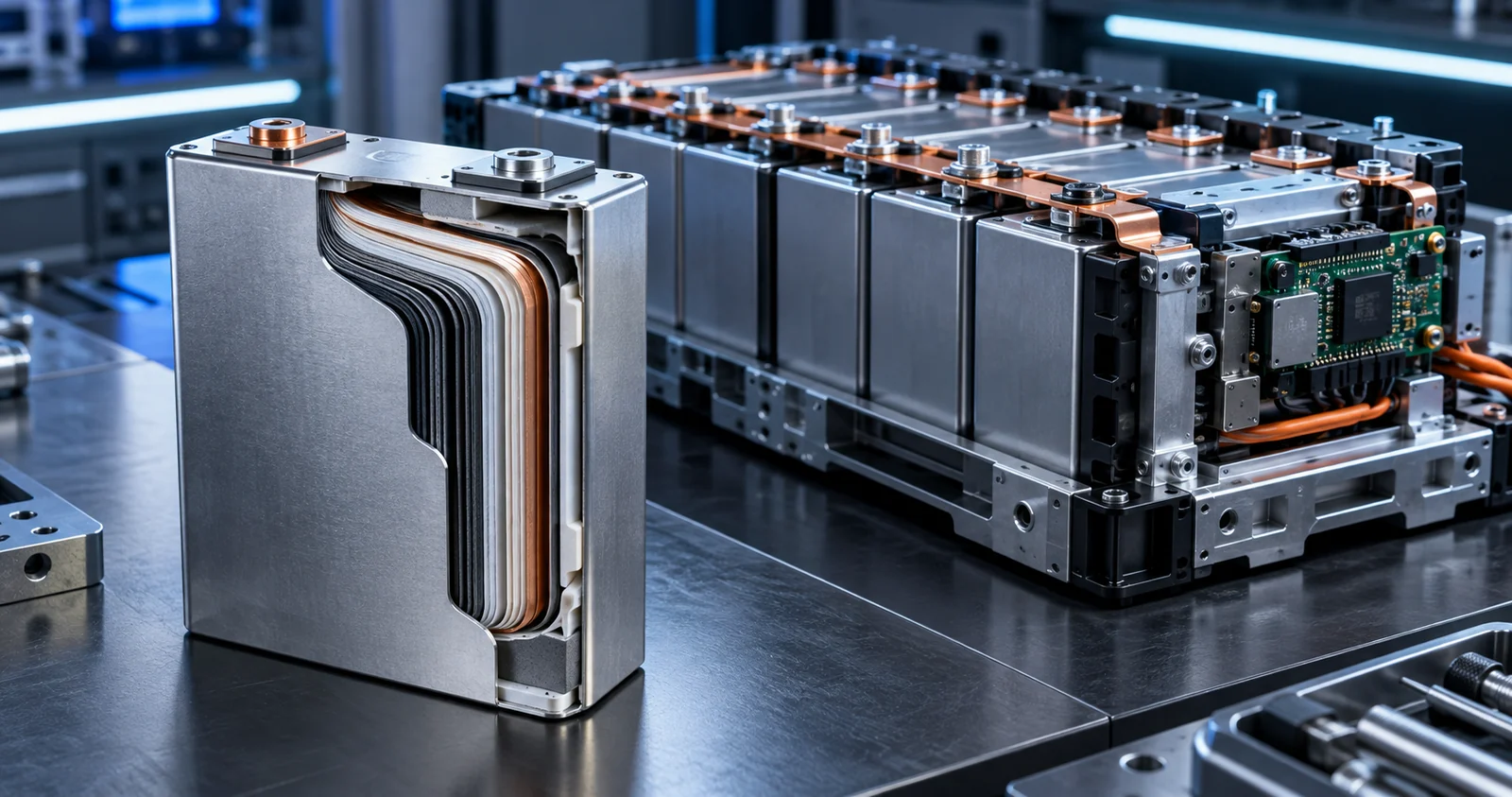
AI concept illustration of a battery module, identity marker, provenance records and authorised access
RESEARCH INSIGHT

A battery passport is more than a QR code: supplier readiness for 2027

The EU battery passport has a defined scope, but not every field becomes mandatory at once. Translate 2026 guidance into ownership, evidence lineage, access control and a testable minimum pilot before buying a platform.

Read the article & use the worksheet

The difficult questions sit behind the code: which battery the data describes, who is responsible, who can see it and who updates it after a status change. Start with product scope and application dates, then test one real battery’s lifecycle; do not publish the entire supply chain by default.

Open article ↗
AI concept illustration of factory battery storage cabinets, power equipment and conceptual dispatch curves
RESEARCH INSIGHT

Cheaper batteries, uncertain savings: the economics of factory storage

Storage value depends on load, tariffs, efficiency and dispatch. A 2026 operating case and an inspectable scenario model separate energy arbitrage, demand savings and delivery requirements before procurement.

Read the article & explore the calculator

A factory storage decision cannot rest on the battery price per kWh. Establish when charging is feasible, how much expensive grid energy it replaces, whether it reduces the billed peak and whether benefits cover delivery and continuing operation. The tool below screens the question; it does not replace interval dispatch or project cash-flow analysis.

Open article ↗
AI concept illustration of a wind turbine with a fractured composite blade in a wind farm; not a real accident photograph
RESEARCH INSIGHT · CLEAN ENERGY

Wind turbine blade debris: evidence on fibres, exposure and failure risk

Blade erosion and debris incidents deserve action. Coating microplastics, glass-fibre exposure and structural failure need different evidence. Field observations, 2026 coating research and a real incident show what to measure and who should respond.

Explore the architecture & project

Blade damage and debris release are real problems, and fibrous glass dust has recognised irritation hazards. Yet fragments on the ground beneath ageing blades do not alone prove long-term harm to nearby residents. We separate release, environmental transport, human exposure and structural incidents to identify evidence that can support action and procurement.

Open article ↗
AI concept illustration of a green-product prototype, engineering components, design documents and manufacturing fixture
DESIGN NOTE

Why does green technology need design management?

Between having a technology and shaping a product lie questions that teams need to answer together.

Read the note

Bringing a technology into a product means asking whose problem it solves, how it will be used and under what conditions adoption makes sense. Our interest extends from materials and functions to needs, manufacturing conditions and product development.

We advocate discussing environmental goals at the concept stage and aligning research, design and business around a shared question: how does this technology create value that people can understand and use?

This is a design perspective. The related systematic review provides background; this note does not report new empirical findings.

Related research ↗
Open article ↗
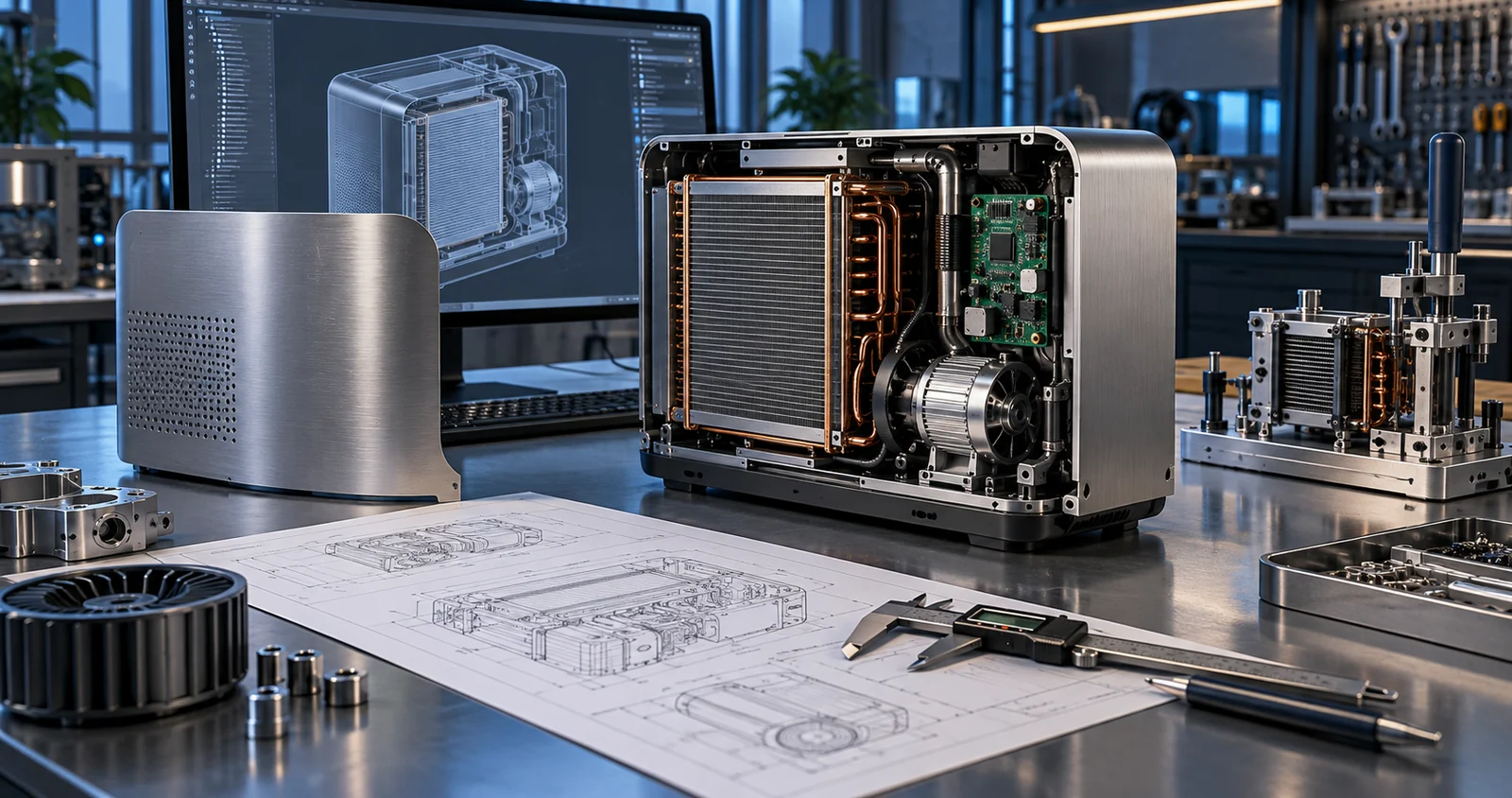
AI concept illustration of a digital design model, physical product alternatives and a testing fixture
DESIGN NOTE

AI in design starts with the decision it supports

Our interest is in how AI can help frame questions, compare options and organize evidence.

Read the note

AI can enter a design process through a defined task: organizing needs, generating concepts for discussion or helping a team compare alternatives. Clear tasks make usefulness easier to assess.

Our design principle is to retain a place for evidence and human judgment. Generated content can begin a discussion; decisions about materials, environmental impacts or technical performance should return to verifiable information and validation.

This perspective guides design exploration. It is not a test result for a particular AI tool.

Open article ↗
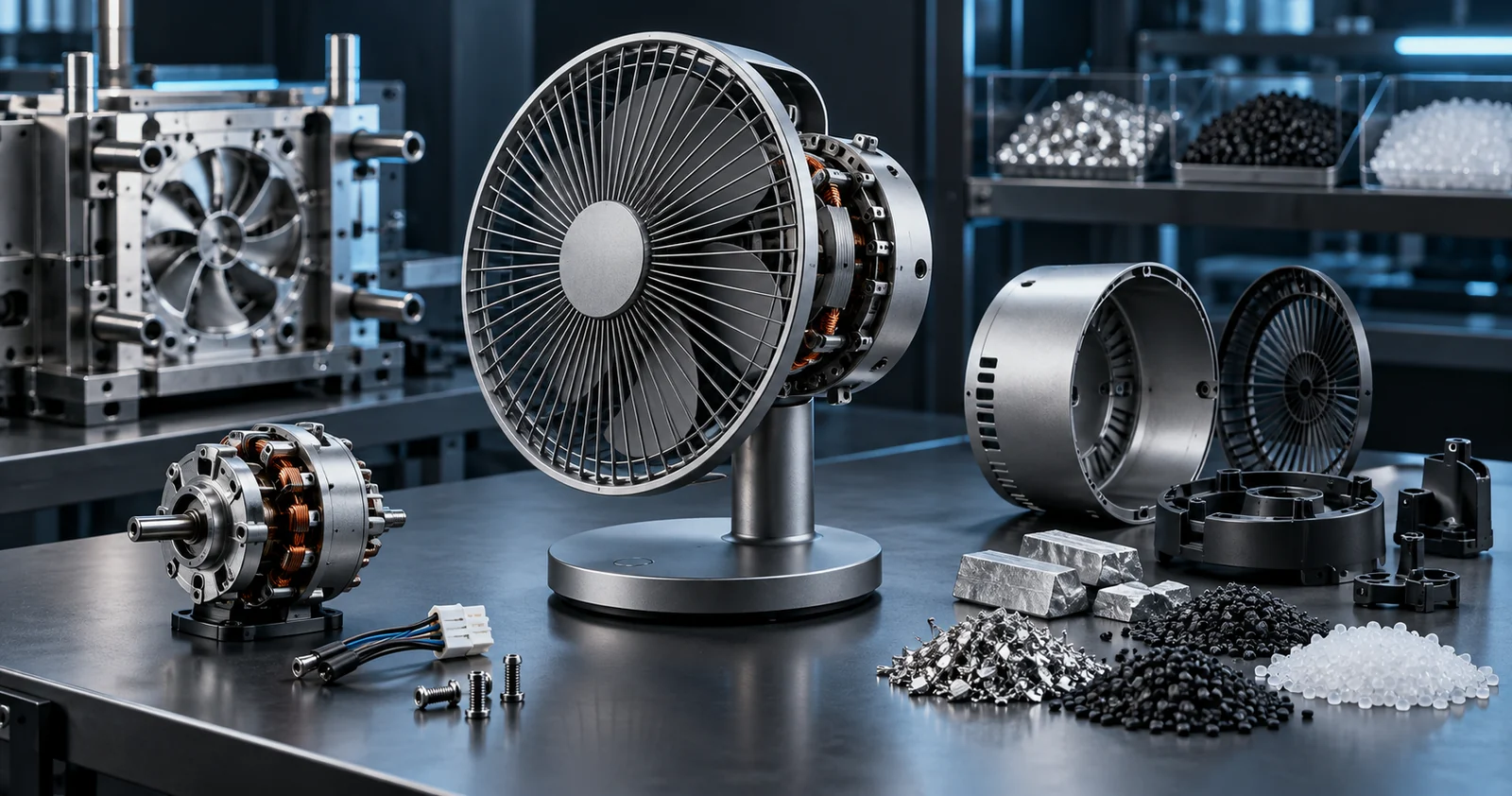
AI concept illustration of a modular fan, replacement parts, separated materials and manufacturing tooling
DESIGN NOTE

Ask lifecycle questions at the beginning

Beyond materials, consider manufacturing, use, maintenance and what happens after use.

Read the note

At the concept stage, we recommend a lifecycle question list: where do materials come from, how is the product made and transported, can it be repaired, and what happens after use?

The list identifies missing evidence and brings environmental goals into early design discussions. It does not replace lifecycle assessment, and labels such as recyclable or recycled material do not by themselves establish overall environmental performance.

For future projects, our aim is to turn these questions into design requirements and examine key choices when data becomes available.

Open article ↗

04 / OUR PRINCIPLES

A point of view on the future.<br>A responsibility for what we create.

01

Ask the next question

Understand user and business problems before choosing technology and features. Add AI where it helps the task.

02

Support judgment with research

Ground decisions in traceable evidence and explicit assumptions, with limitations clear enough to discuss.

03

Connect research, design & development

Connect needs research, interface design and development around one goal, bringing prototype and user feedback back into the project.

04

Create value that endures

Start with a manageable scope and consider real use, maintenance costs and future iterations so the product can improve over time.

05 / COLLABORATION

Contact MY CREATIVE CENTER

If a question in our research relates to your work, we can discuss whether a digital tool, AI application or custom service could help.

Bring an existing workflow, a product idea or an experience to improve. Together we can identify what needs discovery, research and development.

<strong>Possible starting points:</strong>

  • AI assistants, knowledge applications and workflow prototypes;
  • Website and digital product design and development;
  • Brand identity, graphic design and product communication;
  • Needs research, approach comparisons and prototype validation for these projects.

The company coordinates the project and communication, with Mgreen Lab research embedded in the work.

Leave a message ↓

06 / START A CONVERSATION

Let’s explore<br>what comes next.

Tell us about the workflow, website or digital product you want to improve and the problem that matters most.

AI APPLICATIONSDIGITAL PRODUCTSRESEARCH TO PRACTICE

Leave a message directly here, without leaving this page.

Please write at least 10 characters.0 / 4000

Messages are private to the company for follow-up. Please avoid sensitive or confidential information.

FOUNDER

<strong>Ma Ye</strong><br>Founder of MY CREATIVE CENTER and researcher at Mgreen Lab.

Explore the founder’s research & ventures ↗
Top
MY / INTELLIGENCE

AI consultation assistant

Hello, I’m MY’s AI assistant. Ask about our AI applications, digital product services and how Mgreen Lab supports projects.

AI replies are for initial guidance. OpenAI processes this chat; please avoid sensitive information.